Short answer: verify seven things in this order — (1) is it a real manufacturer with its own cleanroom, (2) what material grade is used, (3) how is sterility achieved, (4) does it hold dimensional standards, (5) what documentation ships with each batch, (6) what are the real MOQ and lead times, and (7) can it do private label. Everything else is secondary.
Below is what each check actually looks like, and the specific answers a serious supplier should be able to give you without hesitation.
1. Manufacturer or trading company?
This is the single most common source of trouble. A trader can quote any product at any price, but cannot control the mould, the resin lot or the sterilization run — which is exactly where batch-to-batch variation comes from.
Ask for:
- Cleanroom class and location. A real producer will state the class (e.g. 100,000-class) and confirm the cleanroom is its own, not a subcontractor’s.
- Moulding capability. Automated injection moulding and assembly lines in the same facility means the producer owns its tooling.
- In-house sterilization. Gamma irradiation to a defined SAL is a process the manufacturer should be able to describe, not outsource blindly.
Cross-check the legal entity name on the quotation against the name in the company’s published records. If the legal entity is a different company from the brand, ask which one is the manufacturer of record.
2. Material grade: the difference between “PP” and “USP Class VI PP”
“Polypropylene” on its own tells you nothing about whether the part is safe for cell culture or PCR. The grade that matters for lab consumables is USP Class VI, the biocompatibility classification used for materials in contact with biological samples.
For PCR and cell-culture work you should also expect:
- DNase-free and RNase-free — otherwise residual nuclease activity degrades your template or your RNA.
- Pyrogen-free, typically stated as endotoxin < 0.1 EU/mL.
- No mold-release agents and no color additives, both of which can leach and interfere with fluorescence readouts or cell growth.
A supplier that can only say “medical-grade plastic” has not answered the question.
3. Sterility: ask for the SAL, not the word “sterile”
“Sterile” is a claim; SAL 10⁻⁶ is a specification. SAL (Sterility Assurance Level) of 10⁻⁶ means a probability of fewer than one non-sterile unit in a million. Gamma irradiation to SAL 10⁻⁶ is the common route for single-use plastic consumables.
Also ask whether the product is supplied sterile or non-sterile as standard, and whether both options exist — many consumables are legitimately offered non-sterile at a lower price.
4. Dimensional standards and instrument compatibility
For microplates and PCR consumables, the governing standard is SBS (Society for Biomolecular Sciences) footprint. A plate that misses the SBS footprint by a fraction of a millimetre will still physically sit in the instrument but can produce uneven heat transfer — which shows up as inconsistent Ct values rather than an obvious error.
Ask which instruments the supplier has verified compatibility with, by model — for example ABI (7500, QuantStudio), Bio-Rad (CFX96) and Roche (LightCycler 480). A vague “compatible with most instruments” is a warning sign.
5. Documentation: what should ship with every batch?
At minimum:
| Document | What it should cover |
|---|---|
| CoA (Certificate of Analysis) | Sterility, endotoxin, cytotoxicity, RNase/DNase residues |
| Third-party test report | Available per batch on request |
| Certificate of origin | Required by many customs authorities |
| Trade documents | Those your destination market specifically requires |
If a supplier cannot produce a CoA on request, stop there.
Note on certifications: ISO 9001 / ISO 13485 / CE claims should be backed by a certificate number and issuing body. If a supplier cannot give you those, treat the claim as unverified.
6. MOQ and lead time: the numbers you should hear
Realistic answers from a manufacturer with stock:
- Stock items: no minimum, orderable from a single pack.
- Stock lead time: typically 1–2 working days after order confirmation.
- Custom / OEM orders: MOQ depends on the specification (colour, printing, packaging, sterilization), so it is quoted per project rather than published.
- Custom lead time: the fastest realistic figure is around 15 working days, with the exact time confirmed in the quotation.
Be suspicious of a custom lead time quoted as a fixed number of days before anyone has seen your specification.
7. Private label and custom manufacturing
If you intend to sell under your own brand, confirm the supplier can handle:
- Tube and cap colour customisation
- Laser-printed logo (permanent, unlike a label)
- Barcode / QR and, for biobanking, multi-code formats
- Individual packaging and custom sterilization options
Ask whether they can supply trial samples before a production order, and whether they can send plates or strips for on-instrument testing — that final step is what actually derisks a switch of supplier.
Questions to ask on the first call
- What cleanroom class do you produce in, and is it your own facility?
- Which material grade do you use — is it USP Class VI?
- What SAL do you sterilize to, and by which method?
- Can you send a CoA from a recent batch today?
- Which instrument models have you verified SBS compatibility with?
- What is your MOQ for a stock item, and for a custom print?
- Can you send a trial sample, and can we test it on our instrument first?
A supplier who answers all seven concretely is worth a trial order. One who deflects on questions 1, 3 or 4 is not.
Frequently asked questions
Is it cheaper to buy lab consumables from a trading company? Often on the quoted unit price, rarely on total cost. Traders add margin and cannot control batch variation, so the cost appears later as inconsistent assay results or rejected lots.
What is a normal MOQ for lab consumables from China? For stock items, a single pack is reasonable — that is the normal offer from a manufacturer holding inventory. For custom OEM work the MOQ is driven by the moulding and printing setup for your specific specification.
How long does shipping take? Production lead time and shipping transit time are separate. Stock items ship in 1–2 working days; custom orders are typically around 15 working days. Transit depends on the method — international courier, air freight or sea freight — and is quoted with the order.
Do I need an import licence for plastic lab consumables? Plastic laboratory consumables are generally not specially regulated, so most destinations require no additional licence. Specific customs and certification requirements should still be confirmed for your market, and a supplier with export experience can prepare the origin and trade documents.
Related BUNSEN products
- PCR plates (96 / 384-well, SBS standard)
- Cryovials (2 mL, USP Class VI, -196°C to 121°C)
- Pipette tips (10 / 200 / 1000 µL, filtered & racked)
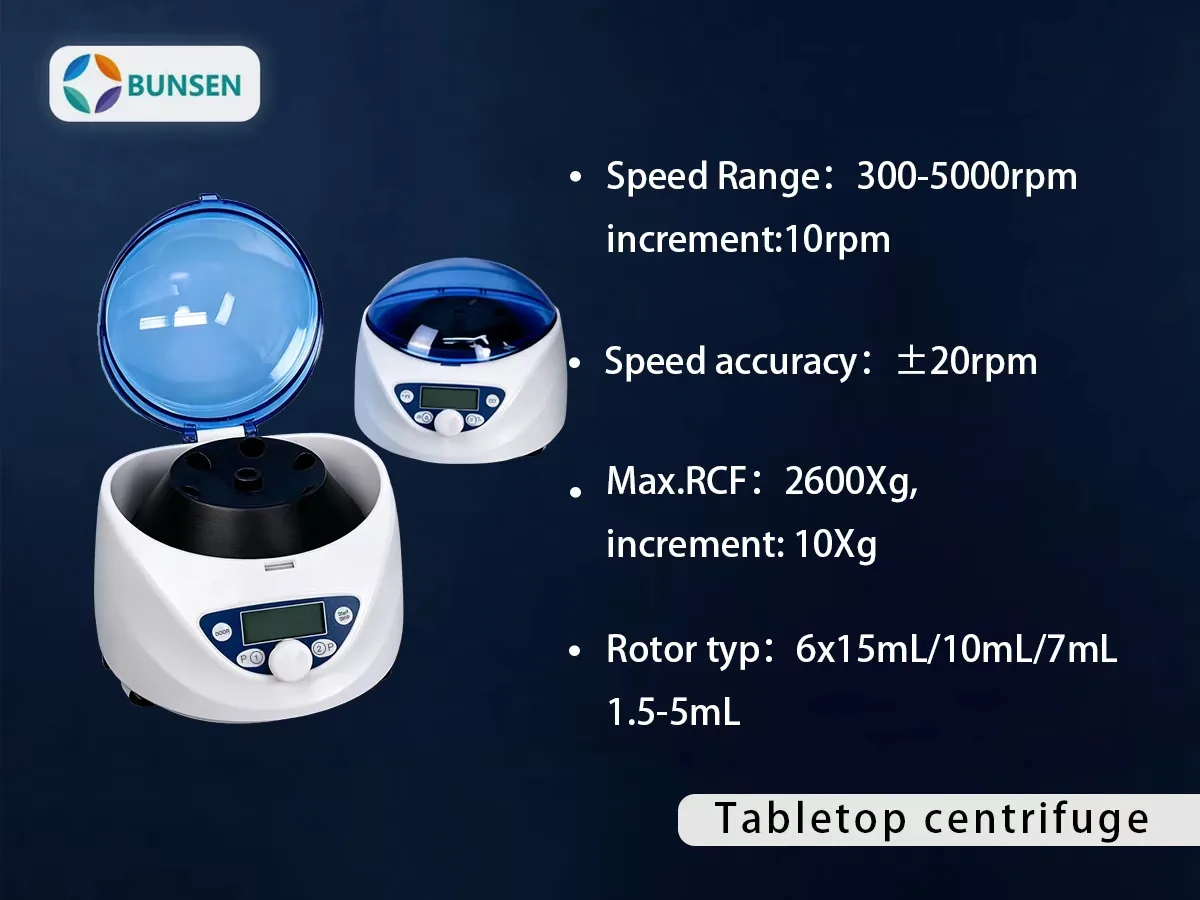
- Tabletop centrifuge (300–5000 rpm, 6 × 15 mL)
- Product Center — all BUNSEN lab consumables & instruments
BUNSEN is a registered manufacturer in Tianjin, China, producing in its own 100,000-class cleanroom with gamma sterilization to SAL 10⁻⁶. Every batch ships with a CoA covering sterility, endotoxin, cytotoxicity and RNase/DNase residues.
Browse the full product range, or request a sample or quotation.
Note: The information on the scientific research products above is for reference only!