A filtered tip only protects the experiment if it fits the pipette properly. Two things have to happen at once: the cone of the tip has to seal against the nozzle, and the filter has to sit far enough up the barrel that it never touches liquid. When both are right, the tip removes aerosol from the airflow and the pipette delivers the volume it was calibrated for. When either is wrong, you get a leak, a short aspiration, or a filter that has been wetted and has stopped filtering.
How the tip and the pipette work together
A filtered tip carries a hydrophobic high-density polyethylene filter inside the barrel. It intercepts more than 99 % of aerosol that backflows from the sample, which keeps the inside of the pipette clean, stops carry-over between samples, and removes the most common cause of false-positive PCR results.
For that to work, the tip cone has to seat on the nozzle without a gap. Any gap means the negative pressure generated by the piston is not fully transmitted to the liquid, and the pipetting error moves outside ±1 %. In a correctly matched system the filter is also specified so that its airflow resistance does not obstruct the return stroke of the piston — otherwise aspiration at very small volumes becomes incomplete.
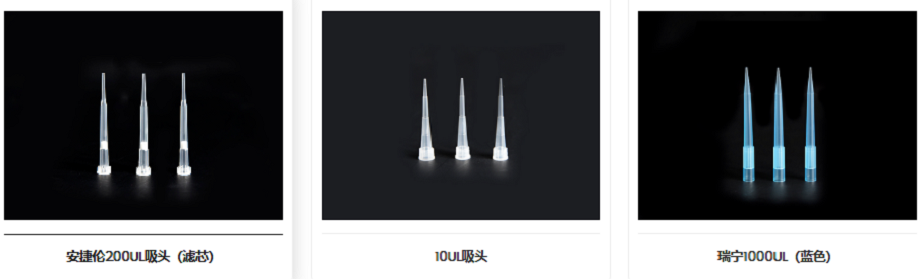
Matching tip size to pipette range
| Tip range | Pipette range | Typical use |
|---|---|---|
| 0.1–10 µL | 0.5–10 µL | qPCR, single-cell sequencing, library preparation; the fine, often extended tip keeps capillary action from distorting the volume |
| 10–100 µL | 10–100 µL | PCR set-up and nucleic acid extraction, including multichannel work; a low-binding wall reduces residue of nucleic acid and enzyme |
| 100–1000 µL | 100–1000 µL | Standard extraction and reagent aliquoting, on manual and motorised pipettes across the leading brands |
| 1–5 mL | 1–5 mL | Bulk nucleic acid extraction and medium preparation; the filter balances flow rate against aerosol retention |
Fitting the tip to your platform
Manual pipettes
Press the tip on vertically and give it a slight twist to seat it. Do not hammer it on — forcing the tip deforms the cone and is the usual reason a tip will not eject cleanly. To check the seal, invert the pipette for ten seconds: if nothing drips, the fit is good.
Most pipette ranges are colour-coded, so matching the colour of the tip to the colour of the pipette removes most of the risk of picking the wrong box. If a tip will not eject, or the pipette drips during dispensing, the tip is simply not the right model for that pipette and should be replaced rather than worked around.
Automated pipetting workstations
Robotic platforms need tips held to tight tolerances — typically ±0.2 mm in length and ±0.1 mm in diameter — so that the arm can pick and place them repeatably. Tips outside tolerance either drop out of the holder or jam in it, and both stop the run.
Dedicated platforms such as Rainin LTS and Agilent Bravo use their own tip geometry, so they need the platform-specific tip rather than a universal one. Some racks carry optical identification marks that the instrument reads automatically, which allows the run to proceed without manual confirmation.
Once the fit is right, the system supports continuous high-throughput pipetting. In sequencing sample preparation and high-throughput screening, the reproducibility of dispensed volume is markedly better than the same work done by hand.
Using the system through a molecular workflow
Before use. Check that the filter is intact and that the packaging states DNase-free, RNase-free and pyrogen-free. A substandard tip introduces contamination before the experiment has started.
While pipetting. Keep the pipette vertical, and never let the liquid level reach the filter. Once the filter is wetted it loses its hydrophobic behaviour and stops intercepting aerosol, which is exactly the failure you bought the filter to prevent.
Maintaining the pipette. Check piston airtightness at regular intervals. If accuracy has drifted, clean the inside of the pipette before continuing — residue left by aerosol will affect every sample that follows.
Do not reuse. A filtered tip is a single-use consumable. Autoclaving or repeated sterilisation damages the hydrophobic structure of the filter and leaves the tip with no aerosol protection at all.
Related reading
Note: The information on the scientific research products above is for reference only!
Leave a Reply