How to choose a low-speed benchtop centrifugation machine suitable for a research laboratory
When selecting a low-speed benchtop centrifugation machine for a research laboratory, focus primarily on the experimental context, prioritising suitability of specifications and long-term stability, and avoid the common pitfalls of focusing solely on low price or the highest rotational speed.
Step 1: First, clarify the experimental requirements
Let’s first outline the three common types of laboratory scenarios to narrow down the selection criteria straight away:
Routine specimen Pre-treatment (serum Separation, urine sedimentation, standard solid–liquid separation): A standard low-speed benchtop centrifugation machine is sufficient; no additional cooling function is required.
Live cell separation, heat-sensitive protein / enzyme specimen processing: it is essential to select a low-speed centrifugation freezer to avoid friction-generated heat during the centrifugation process, which could damage the viability of the samples.
Batch specimen processing (e.g. 96-well plate, 50 mL centrifuge tube batches centrifugation): prioritise models that support large-volume horizontal rotors to minimise time lost due to batch processing.
Step 2: Parameter matching
These parameters directly determine the separation efficiency and the experiment reproducibility, and serve as the criteria for selecting the appropriate model:
Prioritise the relative centrifugation force (RCF) rather than focusing solely on the maximum rotational speed
The efficiency of separation is determined by the centrifugation force (in ×g), rather than simply by the rotational speed. At the same rotational speed, the actual centrifugation force generated by rotors of different radii may differ by a factor of more than two. Conventional cell harvesting requires 200–600×g, whilst standard solid–liquid separation can be adequately covered by 1000–3000×g. Models that support direct RCF setting should be prioritised, as this facilitates the transfer of experimental methods and the reproducibility of results.
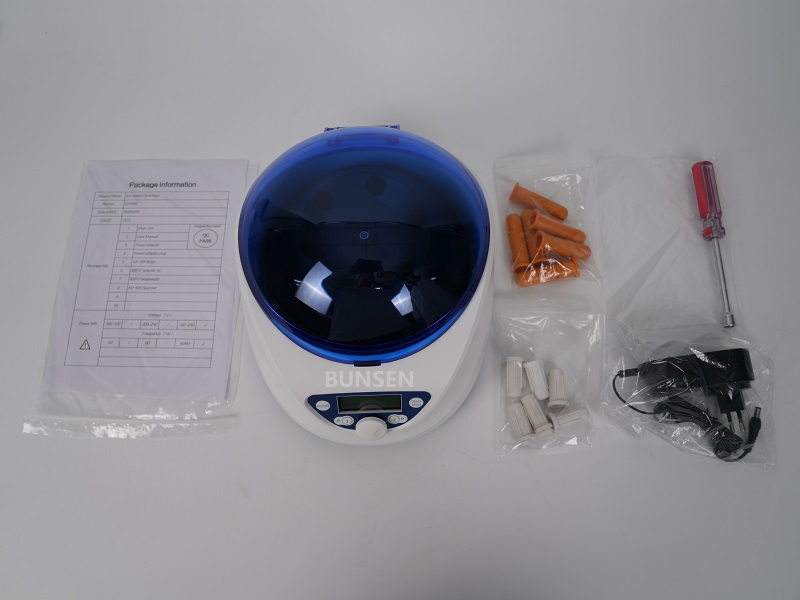
Capacity and Rotor Compatibility
Based on the laboratory’s maximum single-batch processing capacity of specimen, ensure that the rotor well positions are compatible with commonly used centrifuge tube sizes (15 mL/50 mL conical tubes, blood collection tubes, etc.) to avoid the problem of ‘purchasing a machine only to find it cannot accommodate standard consumables’. Prioritise a main unit that supports rotor replacement, allowing for subsequent expansion to include angle rotors and horizontal rotors as required, thereby catering to both rapid sedimentation and clear stratification requirements.
Motor and Vibration Damping Performance
You should definitely avoid models with brushed motors and prioritise brushless inverter motors, as these prevent carbon dust from contaminating samples and can reduce long-term maintenance costs by over 70 per cent. Also ensure that the equipment is fitted with a multi-layer vibration-damping structure, with noise levels below 60 dB during continuous operation and minimal vibration, to prevent the disruption of the specimen stratification caused by excessive vibration.
Step 3: Verification of security and configuration details
In research laboratories where equipment is used intensively and frequently over the long term, these configurations directly reduce experimental risks:
Essential safety features must be included: unbalanced protection, overspeed protection and electronic door locks. It must also be ensured that the lid can be opened manually in the event of a power failure to prevent specimen from being accidentally trapped inside the chamber.
Temperature rise control: For standard models, the temperature rise inside the chamber must not exceed 5 °C during 30 minutes of continuous operation; for refrigerated models, temperature control accuracy must be within ±1 °C to prevent temperature fluctuations from causing the inactivation of heat-sensitive samples.
Ease of use: Give priority to models that support parameter presetting and digital displays, as these allow direct access to commonly used centrifugation programmes, thereby reducing human error caused by repetitive settings.
Step 4: Assessment of long-term running costs and after-sales service
Avoid low-priced models with reduced specifications: Some low-priced machines feature downgraded specifications in terms of rotor materials and drive systems, which can lead to rapid rotor wear and inconsistent separation results from batch to batch.
Priority should be given to models with average annual operating and maintenance costs that are less than 8 per cent of the purchase price. It is essential to confirm that the supplier can provide a long-term supply of rotor spare parts and on-site maintenance services, in order to avoid prolonged downtime following equipment failure, which could disrupt the progress of experiments.
Under the same specifications, reliable domestic models offer better value for money, costing 30–50 per cent less than imported equipment, whilst providing a faster after-sales response and meeting the precision requirements of routine scientific research experiments.
Note: The information on the scientific research products above is for reference only!
Leave a Reply