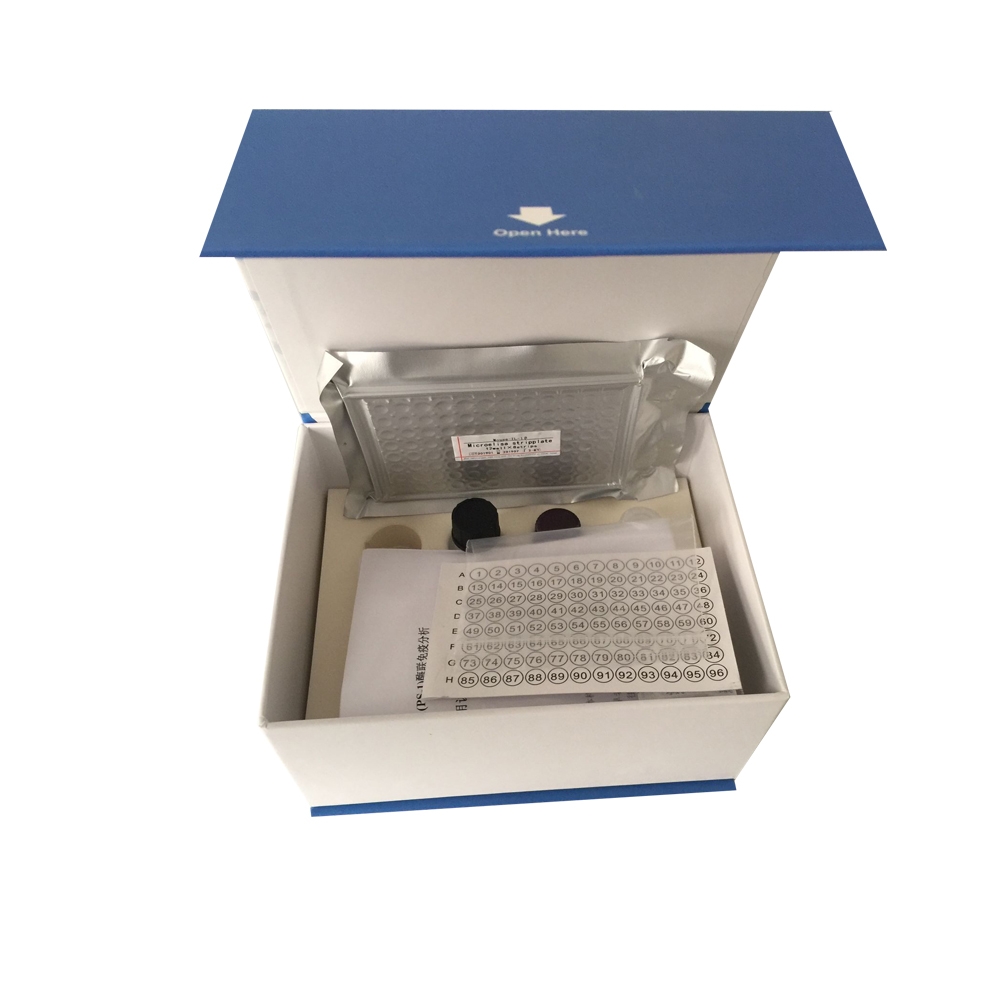
The Human IL-34 ELISA kit is a double-antibody sandwich assay for quantitative detection of interleukin-34 in serum, plasma, tissue homogenates and cell culture supernatant. IL-34 signals through CSF-1R and is studied mainly in immune-inflammatory and tumour-related mechanisms, which is why most users need both a wide dynamic range and a low detection limit at the same time.
Performance specifications
| Parameter | Value |
|---|---|
| Detection range | 23.5 – 1,600 pg/mL |
| Limit of detection | 5.86 pg/mL |
| Intra-assay CV | < 8 % |
| Inter-assay CV | < 10 % |
| Formats | 48T and 96T (96-well format: 80 sample wells plus 16 standard wells) |
| Storage | 2–8 °C, protected from light; 6 months unopened; never freeze |
The range covers the great majority of physiological and pathological concentrations, and the 96-well format is built for throughput: 80 samples on one plate without splitting the run.
Sample types
- Body fluids: human serum, EDTA- or heparin-anticoagulated plasma, urine, pleural and ascitic fluid, cerebrospinal fluid.
- Tissue: supernatant from tissue homogenised in pre-chilled PBS and centrifuged.
- Cell work: cell culture supernatant and cell lysate supernatant.
Handling samples before the assay
Decide the storage route before you collect, not after. Whether the analyte survives your handling is a collection question, not an assay question.
- Same-day assay: store at 4 °C.
- Next-day assay: freeze at -20 °C; -70 °C is better where available.
- Repeated freeze–thaw: avoid it. Aliquot at collection so each tube is thawed once.
Questions we get most
What should I look for in a plate reader?
Reading speed, accuracy, reproducibility, measurable range and linearity. A good reader resolves to 0.001 with about ±1 % accuracy and 0.5 % reproducibility. Keep it out of direct sunlight, work at 15–30 °C room temperature, and preheat for 15–30 minutes before use — the last point is the one most often skipped, and it shows up as drift across a plate.
How important is the washing step?
It is not a reaction step, but it decides whether the run works. Washing is what separates bound from unbound enzyme label: it removes material that never bound to the solid phase, and interfering substances that adsorbed non-specifically during the reaction. Done carelessly, it produces high background and poor replicate agreement.
How do I handle the different sample types?
Serum, plasma, urine, pleural and ascitic fluid, cerebrospinal fluid and cell culture supernatant are all handled as liquids — clarify by centrifugation before assay and keep them cold while you work. Tissue has to be homogenised in pre-chilled PBS and centrifuged, and the supernatant is the sample.
Do you offer a testing service?
Yes. With a kit purchase, samples can be sent to us for testing at no charge: aliquot into EP tubes, label each by number, pack in a polystyrene box with dry ice and ice packs. The test report is issued within 7 working days of receipt and includes the instruction manual, the instrument models used, the data and the calibration curves.
Related reading
Note: The information on the scientific research products above is for reference only!
Leave a Reply