PCR plate Key Considerations for Selection
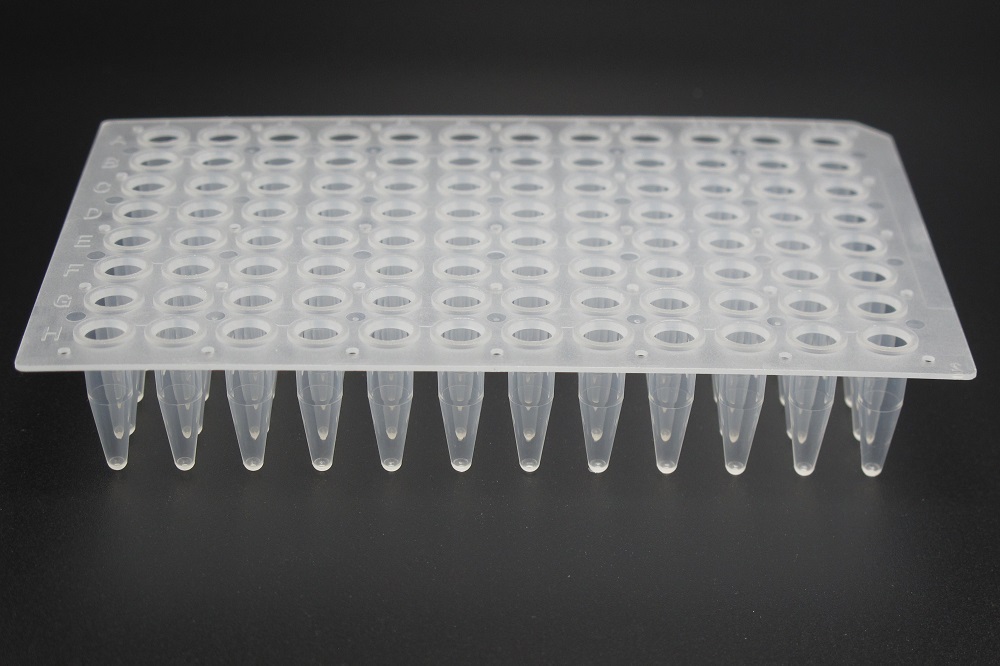
PCR plate serves as the medium for thermal cycling in molecular experiments; the choice of model directly determines the efficiency of heat transfer and the outcome of the experiment reproducibility.
Well type compatibility: non-skirted plate Compatible with metal wells in traditional PCR instruments; semi-skirted plate Compatible with the vast majority of qPCR instruments and automated workstations; full-skirted plate With a tab, suitable for high-throughput robotic handling to prevent well misalignment.
Material and well type selection: Medical-grade polypropylene (PP) is the preferred choice; the thin-walled design ensures uniform heat conduction, with a thermal cycling speed 30 per cent faster than that of thick-walled plates; for routine experiments, select 96-well plate; for ultra-high-throughput screening, select 384-well plate; well volumes of 0.1 mL or 0.2 mL must be compatible with the instrument’s thermal module.
Biosafety requirements: It must be confirmed that the plates are labelled as ‘DNase/RNase-free’, ‘pyrogen-free’ and ‘endotoxin’, to avoid false positives or CT value drift in qPCR caused by exogenous nucleic acid contamination.
sealing film Selection logic
The purpose of sealing film is to prevent evaporation and contamination; it must be matched to the type of experiment and the PCR plate parameter.
Test Scenarios Recommendations sealing film Type Performance Requirements
Standard PCR: Polypropylene (PP) adhesive sealing film / aluminium foil heat-seal film; temperature resistance: -40°C to 120°C; excellent sealing performance; withstands high-temperature cycling at 95°C
High-transmittance, pressure-sensitive films for quantitative fluorescent qPCR: light transmittance >90 per cent, low autofluorescence, and no interference with fluorescence signal detection
Long-term -80°C specimen storage Thickened adhesive sealing film with extremely low water vapour permeability; does not become brittle or delaminate at low temperatures
High-throughput automated workstation; custom heat-seal film with a thickness tolerance of ≤±0.02 mm, suitable for use with fully automatic board sealing machines
PCR experiments involving cell culture: Breathable sealing film Allows gas exchange whilst preventing liquid spillage and cross-contamination
The Complete Process for Standardised Sealing Operations
Following standard operating procedures is key to ensuring an effective seal and avoiding experimental failure; the following steps must be strictly adhered to throughout the process:
Preparation: Disinfect the workbench with UV light for 30 minutes; wear powder-free gloves; immediately reseal the bag after removing a single sheet of film to ensure that the remaining consumables DNase/RNase-free remain free from contamination.
Application: Gently peel off the backing along the tangent, align one end of the adhesive side with the edge marked PCR plate, and gradually smooth it onto the surface at a 30° angle, taking care not to touch the adhesive layer at any point to prevent air bubbles or creases from forming.
Even lamination: Using a specialised laminating board or a card with smooth edges, press down twice horizontally and twice vertically, paying particular attention to the edges of the board and the gaps between the holes. Apply firm but not excessive pressure to prevent liquid from spilling out of the holes.
Final quality control: Visually inspect each aperture to ensure there are no gaps around the edges and that the membrane surface is flat and free of creases; after sealing the membrane, leave it to stand for 10 minutes to allow the adhesive bond to strengthen fully, then centrifuge briefly at 500×g centrifugation for 1 minute to remove any air bubbles from the apertures before running the machine.
Points to note for adaptation and avoiding pitfalls
Under no circumstances should ordinary plastic cling film be used as a substitute for the specialised sealing film, as its temperature resistance and sealing properties do not meet the required standards. During thermal cycling, significant evaporation of the liquid will occur, leading to changes in the concentration of specimen and severe deviations in the CT value.
Under no circumstances should opaque aluminium foil be used in qPCR experiments, as it will block the light path, preventing the instrument from detecting the fluorescent signal and resulting in the loss of experimental data.
Where possible, use sealing film from the same brand as PCR plate. As there are tolerances in the hole spacing and flange dimensions of panels from different brands, using third-party, non-compatible films is highly likely to result in issues such as unsealed edges and localised curling.
sealing film This is a single-use consumable; reuse is strictly prohibited. Re-adhesion will result in a significant reduction in bonding strength, which will compromise the seal and make the product highly susceptible to leakage during high-temperature cycling.
If, following the thermal cycling test, the sealing film is found to be blistered or to show localised delamination, this indicates that the temperature resistance of that batch of film does not meet the required standards. It must be replaced immediately with a compliant product to avoid systematic errors in subsequent experiments.
Note: The information on the scientific research products above is for reference only!
Related BUNSEN products
- PCR Plates & PCR Tubes
- Cryovials & Sample Tubes
- Tabletop Centrifuge & Centrifuge Tubes
- Product Center — all BUNSEN lab consumables & instruments
Browse the full product range, or request a sample or quotation.
Leave a Reply