How to choose a centrifuge tube
Choosing a centrifuge tube is not a matter of picking a size off the shelf. The tube has to match the material you are spinning, the force the run requires, and the way the sample will be handled afterwards. Get it wrong and the failure mode is not a poor result — it is a cracked tube, a lost pellet, or an aerosol release into the rotor chamber.
Start with the material
For standard molecular work, polypropylene (PP) is the sensible default. It handles −20 °C to 120 °C, survives autoclaving at 121 °C, and resists most acids and alkalis, which is why it is the material most laboratory tubes are made from.
Some applications need something else. Ultracentrifugation calls for thin-walled polycarbonate (PC), because the wall has to be light and strong enough to take very high g-forces. Liquid nitrogen storage calls for a tube rated for cryogenic service, such as polyethylene (PE). Strong organic solvents and aggressive reagents are better handled in PTFE or PFA. Glass tubes are for low-speed work only — they should never be run above their rated speed.
Choose the bottom shape
A conical bottom collects the pellet in a small, tight point, which makes it easy to see and easy to resuspend in a small volume; it is the right choice when you are recovering a nucleic acid or protein precipitate. A round bottom spreads the load more evenly around the wall and is less prone to cracking, which is why it is used for high-speed and ultracentrifuge runs. A self-standing tube has a moulded skirt that lets it stand upright on the bench, which suits temporary sample storage.
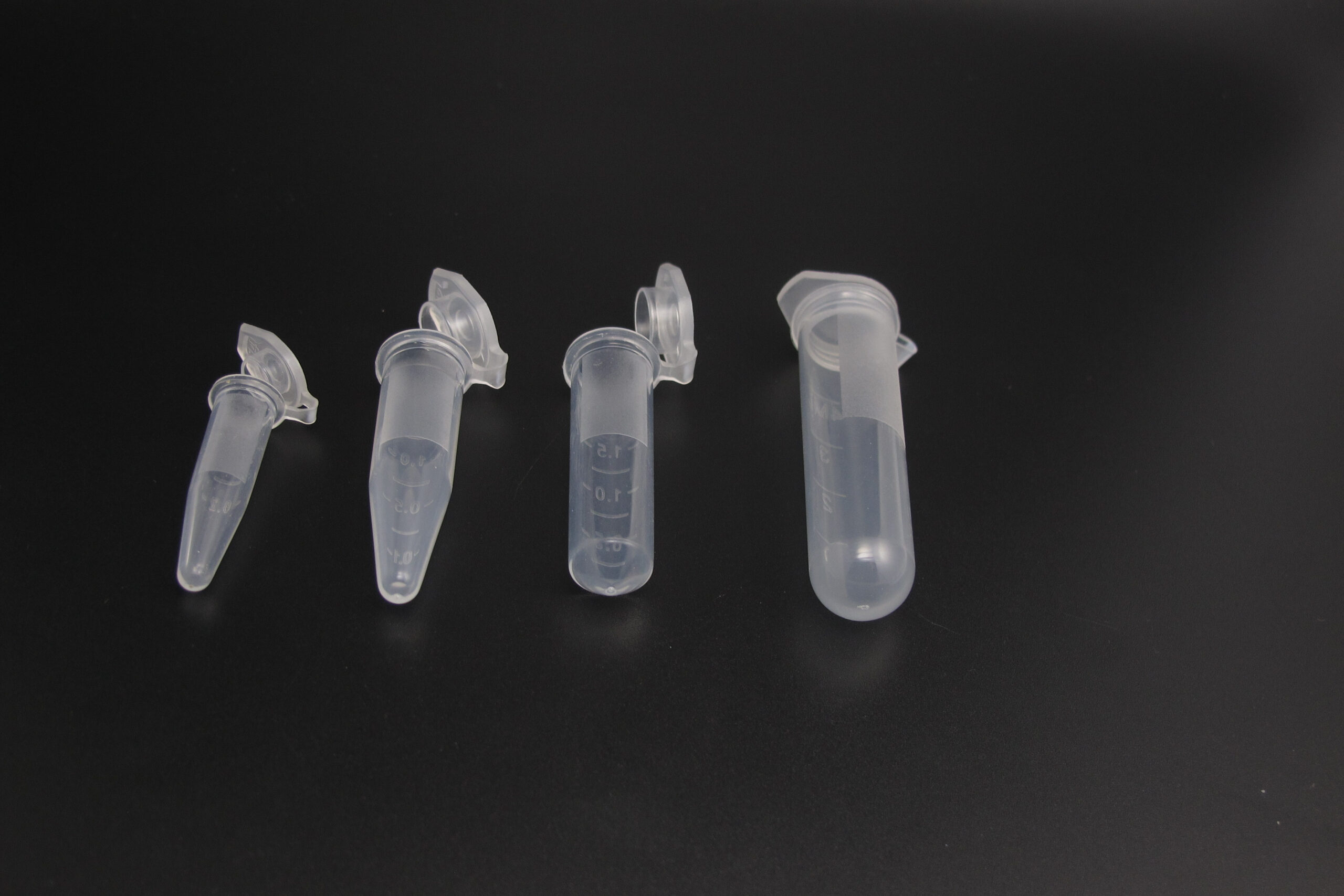
Capacity selection guide
The table below lists what each common capacity is normally used for, and the minimum force a tube should be rated to before you put it in that role. These are application requirements, not a statement of any one product’s rating — always check the figure printed on the tube you are actually using.
| Capacity | Typical use | What to look for |
|---|---|---|
| 0.2 mL / 0.65 mL microtubes | Ultra-low-volume work: nucleic acid aliquots, holding PCR master mix | Rated to at least 15,000 × g; DNase-, RNase- and pyrogen-free |
| 1.5 mL / 2.0 mL microtubes | Nucleic acid extraction, routine protein precipitation, small-volume storage | Rated to at least 20,000 × g — the most common size in a molecular laboratory |
| 15 mL conical | Medium-volume bacterial culture, larger nucleic acid precipitates, reagent aliquots | Conical bottom, fits standard benchtop rotor buckets, rated to at least 6,000 × g |
| 50 mL conical | High-throughput processing, cell suspension harvest, bulk medium preparation | Screw cap, O-ring option for leak protection, rated to at least 12,000 × g |
| 250 mL / 500 mL | Large-scale cell harvest, industrial sample processing | For floor-standing centrifuges only; never run above the rated limit |
Operating practice
Inspect before use. Check every tube for cracks, deformation and a cap that still seals. Confirm that the tube and cap actually fit the rotor bore you are about to use, and that any writing area or graduation is still legible.
Fill and balance. Never fill above about two-thirds of capacity — the headspace is what stops liquid being forced against the cap as the rotor accelerates. Tubes placed opposite each other must match to within 0.1 g. With an odd number of samples, prepare a balance tube of the same type, filled to the same volume with buffer.
rpm is not ×g. Rotational speed and relative centrifugal force are different quantities, and the same rpm produces a very different ×g on a rotor of a different radius. Work from the RCF rating on the tube, not from the number on the dial, and never exceed it.
Let cold tubes equilibrate. A tube taken straight out of a freezer and loaded into a rotor can crack as the wall warms unevenly. Let it stand at room temperature for about five minutes first.
High-risk handling
For toxic or infectious material, use a screw-cap tube with an O-ring seal, and autoclave the tube at 121 °C for 30 minutes before disposal.
If a tube breaks during a run, switch the centrifuge off and leave the lid closed for 30 minutes so that the aerosol can settle. Then put on double gloves and safety glasses, remove the fragments with forceps, and wipe the chamber down twice.
In an ultracentrifuge, fill the tube as specified for that rotor — a partly filled tube can collapse under vacuum. Polypropylene tubes can be reused, but they should be retired once cumulative exposure approaches about 80 % of the rated force, because repeated loading fatigues the wall.
Related reading
Note: The information on the scientific research products above is for reference only!
Related BUNSEN products
- Conical & microcentrifuge tubes — specs, RCF ratings and sizes
- Tabletop centrifuge — 300–5000 rpm, 6 × 15 mL rotor
- Cryovials & sample tubes for liquid nitrogen
- Product Center — all BUNSEN lab consumables & instruments
Browse the full product range, or request a sample or quotation.
Leave a Reply