What the skirt on a PCR plate actually does
A PCR plate’s skirt is the raised plastic frame around the outside of the well array. It has nothing to do with sealing the wells — it exists to give the plate rigidity and to give instruments something to hold. The three formats you will find on a laboratory shelf (non-skirted, semi-skirted and full-skirted) differ only in how much of that frame is present, but that single difference decides which thermal cyclers, sealers and robotic handlers the plate will work with.
Structure and parameter comparison
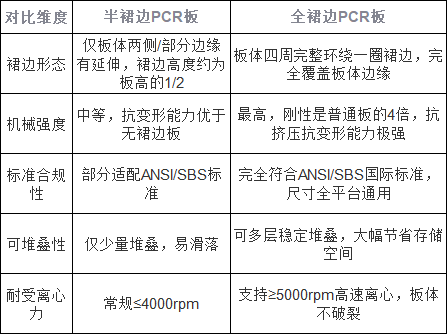
The difference between a semi-skirted and a full-skirted 96-well PCR plate comes down to three things: how rigid the plate is, which instrument can grip it, and therefore what kind of workflow it suits. Both are among the most widely used 96-well formats in molecular biology laboratories, but they are not interchangeable.
Differences in applicable scenarios
Semi-skirted PCR plates — the manual and semi-automated workhorse
A semi-skirted plate has a raised rim on two opposite sides only. That is enough to seat it firmly in the block of almost every standard PCR and qPCR instrument, including manual-loading models from ABI and Roche, which makes it the default choice for routine amplification and genotyping.
The two skirted edges also give you somewhere to write. Sample IDs, dates and run conditions can be marked directly on the plate, or a QR label can be applied, so manual runs stay traceable without a separate log sheet.
Some mid-range liquid handlers can grip a semi-skirted plate by its rim and pipette directly into the wells. That makes it a practical compromise for small to medium-throughput projects, where a lab wants some automation without committing to a fully enclosed workflow.
Full-skirted PCR plates — built for fully automated platforms
A full-skirted plate has a continuous frame around all four sides. The unbroken outer edge lets a robotic arm locate and grip the plate repeatably, which is why it is the standard format for automated nucleic acid extraction workstations and high-throughput screening systems.
The frame also makes the plate considerably stiffer. It withstands the clamping force of press-fit caps and the heat and pressure of a heat sealer without warping, and it keeps its shape through long-term storage, so a full-skirted plate is the safer choice for a large specimen archive.
For that reason it is the usual format in third-party testing laboratories, high-throughput sequencing centres and pharmaceutical screening groups, where plates have to be processed in unattended batches and daily throughput is the constraint that matters.
Non-skirted PCR plates — the cheap option, and when it is enough
A non-skirted plate is simply the well array with no frame at all. It is the cheapest of the three and fine for low-volume manual work in a benchtop thermal cycler, but it flexes more easily, offers nowhere to write, and cannot be gripped by a robot. It is also the format most likely to need a support frame or adapter before it can be centrifuged.
Operating notes
Semi-skirted plates. During high-speed centrifugation, seat the plate in a support frame or adapter. Without it the two unsupported edges can flex under load, and the plate will not sit flat afterwards.
Full-skirted plates. Check that the thermal cycler block is designed to accept a full-skirted plate before loading it. On some instruments the skirt fouls the block, the plate sits slightly proud of the heating surface, and heat transfer to the wells drops — which shows up later as inconsistent amplification.
Sealing. Both formats accept adhesive sealing film and optical flat caps. The full-skirted plate can additionally take aluminium foil heat seals and press-fit caps, because its frame gives the sealer and the cap something to bear against.
Related reading
Note: The information on the scientific research products above is for reference only!
Leave a Reply