Choosing a disposable culture dish comes down to three things: the material, the size, and how it was sterilised. Get those right and the rest — surface treatment, stacking, packaging — usually sorts itself out.
Material: polystyrene is the default
Polystyrene (PS) is the standard for a reason. It is highly transparent, has a smooth surface that is easy to read under a microscope, and most dishes receive a TC (tissue culture) hydrophilic treatment that makes it suitable for adherent cell culture and routine microbiology at a reasonable price.
Its limits are absolute: PS does not tolerate ethanol, acetone or other organic solvents, and it cannot be autoclaved. If the experiment involves either, you need a different material.
Polypropylene and the speciality plastics
Polypropylene (PP) is chemically resistant, survives 121 °C autoclaving, and is tough enough that it rarely cracks in handling. It suits organic solvents, work that needs high- or low-temperature storage, and suspension culture. The trade-off is optical quality — PP is noticeably hazier, so it is a poor choice for high-magnification observation.
Beyond those two, materials become purpose-specific. Polycarbonate (PC) offers high toughness with good clarity and appears in optical work. Cycloolefin copolymer (COC) has low protein adsorption and high light transmission, which makes it the right answer for fluorescence imaging and other high-sensitivity detection. Both cost considerably more, so specify them only when the assay needs them.
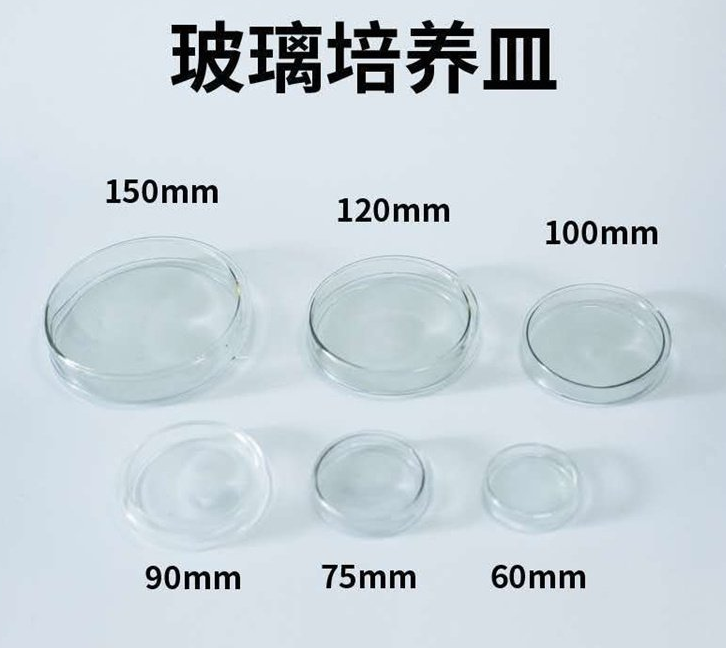
Standard sizes and working volumes
Round dishes follow a small number of standard diameters. The working volume matters as much as the diameter: too little medium and the culture dries at the edges, too much and gas exchange suffers.
| Diameter | Growth area | Working volume | Typical use |
|---|---|---|---|
| 35 mm | ~8 cm² | 2–3 mL | Small-scale observation, single-cell cloning |
| 60 mm | ~21 cm² | 4–6 mL | Routine passaging, preliminary drug screening |
| 90 mm | ~64 cm² | 15–20 mL | Microbial colony counting, settle plates |
| 100 mm | ~55 cm² | 10–15 mL | Larger-scale expansion, virus culture |
| 150 mm | ~145 cm² | 25–30 mL | High-throughput culture, strain expansion |
Multi-well plates (6-, 12-, 24- and 96-well) and square dishes cover the cases where you need many parallel conditions in one footprint.
Sterilisation: gamma versus ethylene oxide
Gamma irradiation suits almost every plastic used for dishes, penetrates the packaging, leaves no residue and does not degrade the polymer at normal dose levels. It is the default for cell culture.
Ethylene oxide (EO) is reserved for materials that cannot take gamma. It works, but you must confirm that residual EO is within the limits set by the relevant standard — residue that stays on the plastic can affect cell growth just as surely as contamination would.
What the labels should say
A compliant single-use dish carries a sterility assurance level (SAL) of 10⁻⁶, meaning a theoretical probability of one non-sterile unit in a million. For cell culture you also want DNase-free, RNase-free and pyrogen-free stated on the certificate, not just on the box — those three are what stop a dish from quietly changing your results.
Choosing in one minute
- Adherent cells, routine work → PS, TC-treated, gamma sterilised.
- Organic solvents or autoclaving → PP.
- Fluorescence or low-adsorption work → COC.
- Pick the diameter from the growth area you need, then set the medium volume from the table above.
Related reading
Note: The information on the scientific research products above is for reference only!
Related BUNSEN products
- PCR Plates & PCR Tubes
- Cell Culture Dishes & Plates
- Product Center — all BUNSEN lab consumables & instruments
Browse the full product range, or request a sample or quotation.
Leave a Reply