A 10 mL round-bottom tube and a 10 mL conical-bottom tube hold the same volume. They are not interchangeable, because the shape of the base decides what the tube is good at: one is built for volume and force, the other for recovering a pellet.
The difference is the base
A round base spreads stress evenly, so it tolerates higher g-force and larger volumes without cracking. A conical base concentrates solids into a tip, so you can pipette off supernatant without disturbing what you want to keep. Everything else — caps, material, graduations — is secondary to that one geometric choice.
Round-bottom, screw cap: volume and force
With a smooth base and uniform wall stress, round-bottom tubes tolerate higher centrifugation forces. That makes them the right choice for density-gradient work and for spinning down large sample volumes where a conical tube would concentrate everything into a tip you cannot easily resuspend.
The wide base also helps in less obvious ways. Solids are less likely to lodge in a corner, so cleaning is easier, and mixing is more effective because there is no dead zone at the bottom.
In PP they autoclave at 121 °C, and the one-piece design including the cap makes them convenient for routine biochemistry, batch pre-treatment of environmental water samples, and temporary storage. They also handle −80 °C, so short-term cryopreservation of standards and reagents works without extra sealing hardware.
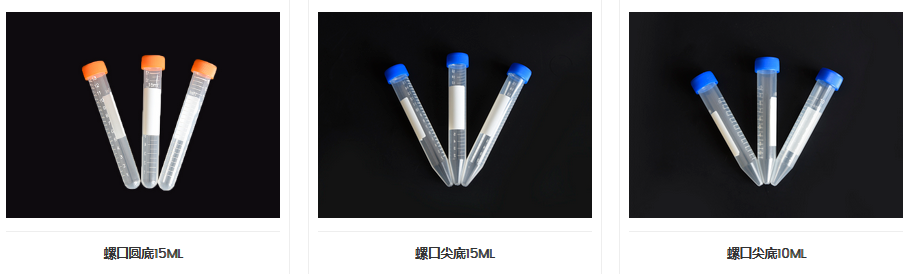
Conical bottom: pellets you can actually see
The pointed base does one job extremely well: it collects the pellet at a single point. For nucleic acid purification, protein precipitation and cell pelleting, that concentration is the difference between recovering most of your sample and losing it against a large flat surface.
It also makes aspiration cleaner. The pipette tip can reach the supernatant above a compact pellet without dragging through it, which is what you want for cell culture work, microorganism collection and isolation from clinical or environmental samples.
The screw cap with an internal gasket seals harder than a push cap, so conical tubes are the better choice for extracting or transporting volatile reagents and for sample shipment where the seal has to hold for days.
The tip is also useful at the bench: it fits into narrow openings, so liquid can be drawn out of the tube directly, which suits assays and micro-chemical work where recovery of a small volume matters.
Side by side
| Round-bottom, screw cap | Conical bottom | |
|---|---|---|
| Best at | Volume, high g-force, mixing | Pellet recovery, clean aspiration |
| Weak at | Recovering small pellets | Very high g-force, large-volume mixing |
| Typical use | Density gradients, water samples, reagent storage | Nucleic acid and protein prep, cell pelleting |
| Seal | Good | Better — gasket screw cap |
Choosing in practice
If the experiment ends with “remove the supernatant and keep the pellet”, use conical. If it ends with “keep the liquid” or “spin a large volume fast”, use round-bottom. If you are storing rather than separating, round-bottom gives you more usable volume for the same tube length, and the flat base stands up on its own.
The common mistake is buying one type for the whole lab to simplify ordering. It works until someone tries to pellet 10⁶ cells in a round-bottom tube and wonders where the pellet went.
Related reading
Note: The information on the scientific research products above is for reference only!
Related BUNSEN products
- Cryovials & Sample Tubes
- Tabletop Centrifuge & Centrifuge Tubes
- Pipette Tips
- Product Center — all BUNSEN lab consumables & instruments
Browse the full product range, or request a sample or quotation.
Leave a Reply