Compact benchtop centrifugation The operating principle of this compact benchtop centrifugation unit is based on a miniature brushless DC motor driving the rotor to rotate at high speed, thereby generating a centrifugation force field far greater than gravitational force. This accelerates the sedimentation and stratification of components of different densities within the mixture, enabling highly efficient separation of trace amounts specimen within a compact footprint.
The physics of separation
By utilising inertial forces centrifugation in place of gravity, the settling process—which would otherwise take several hours under the influence of gravity—is completed in a matter of seconds to minutes, resulting in a several-hundred-fold increase in separation efficiency.
The formula for calculating the relative centrifugal force (RCF) is: RCF = 1.118 × 10⁻⁵ × r × (RPM)², where r is the rotor rotation radius (in cm) and RPM is the rotational speed ( The formula for calculating the force (RCF) is: RCF = 1.118 × 10⁻⁵ × r × (RPM)², where r is the rotational radius of the rotor (in cm) and RPM is the rotational speed per minute. This directly reflects the actual separation efficiency and serves as the core basis for standardising the experiment.
Components of different densities and particle sizes exhibit significant differences in their settling rates in the centrifugation force field: particles with higher density and larger particle size settle rapidly to the bottom of the tube to form a precipitate, whilst components with lower density remain in the upper layer to form a supernatant, thereby achieving stratification.
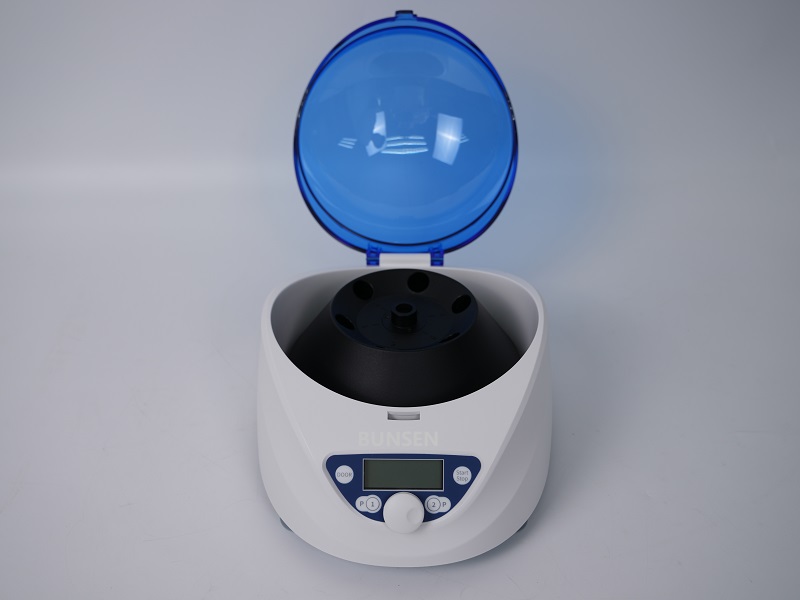
How a mini centrifuge is built
Drive system: Utilises a miniature brushless DC motor, accelerating to maximum speed in 13–20 seconds, with extremely rapid start-stop response and an operating noise level of ≤60 dB, making it suitable for deployment close to a desk.
Rotor system: Mostly tool-free, quick-release composite rotors, compatible with the full range of laboratory micro-volume consumables, including 0.2 mL PCR tube, 1.5 mL/2 mL microcentrifuge tube and other laboratory microvolume consumables across the entire range; some models can be adapted for use with 96-well plates PCR plate via adapters.
Safety control system: Features a built-in automatic imbalance detection module which automatically stops the machine and triggers an alarm when the weight difference between the symmetrical tubes exceeds the threshold; this works in conjunction with the electronic lid lock interlock to prevent safety risks caused by operation with an imbalance.
Chamber structure: Features a stainless steel sealed centrifugation chamber with no hygiene dead zones; after experiments, it can be wiped down directly with 75 per cent ethanol to prevent specimen cross-contamination.
How separation runs in practice
centrifugation Sedimentation mode: This is a mode commonly used in small benchtop centrifugation machines. The drum wall is solid, and the mixture rotates with the rotor; particles with higher density settle directly to the bottom of the tube. It is widely used in nucleic acid extraction, serum separation, and instantaneous centrifugation in PCR systems, amongst other applications.
Microfiltration mode: When used in conjunction with spin column and centrifugation, which contain filter media, a force drives the liquid through the filter membrane, whilst solid particles are retained on the membrane, enabling nucleic acid, adsorption and protein ultrafiltration and other micro-purification operations, serving as a core support mode for molecular biology experiments.
Related reading
Note: The information on the scientific research products above is for reference only!
Leave a Reply