Short answer: no, not in any experiment whose result you intend to rely on. PCR tubes are single-use consumables, and the three failure modes that appear on reuse — carry-over contamination, seal failure and loss of thermal contact — all produce the same outcome: a result you cannot trust and cannot easily troubleshoot.
The longer answer is that reuse is technically possible in a narrow set of low-stakes qualitative situations, under a specific cleaning protocol. This page sets out both, so the decision is made with the mechanism in view rather than out of habit.
Why reuse goes wrong: three separate mechanisms
1. Amplicon carry-over
A PCR reaction is designed to amplify vanishingly small numbers of copies, which makes it uniquely intolerant of residue. A tube that held a previous reaction can carry nanogram quantities of product on the wall and around the cap thread. That is enough to appear in the next run as a band, a signal, or a positive that should not be there — and it is the standard explanation when a no-template control amplifies.
The problem is that you cannot see it, and once a laboratory has an amplicon contamination event, the remedy is not washing a tube. It is decontaminating surfaces, pipettes, racks and often the room.
2. The seal stops being a seal
Every cycle takes the cap through 95 °C. The cap and the tube rim are the parts that experience that heat while under mechanical load from the thermal cycler’s heated lid. After repeated cycles the fit between cap and rim loses precision, and the failure is gradual rather than dramatic: a small amount of liquid evaporates from each well.
The consequence is not a leak you can see. It is a volume that no longer matches the other wells, a concentrated salt and primer mix, and an amplification efficiency that drifts. In qPCR the same loss shifts the baseline and the Cq value.
3. Thermal contact degrades
The ultra-thin wall of a PCR tube is what lets heat move quickly between the block and the reaction. Reuse deforms it slightly — enough that the tube no longer sits flush in the block. Localised contact differences become localised temperature differences, and temperature differences between wells show up as well-to-well variation. Published comparisons of reused tubes report Cq deviations beyond one cycle, which is more than most quantitative assays tolerate.
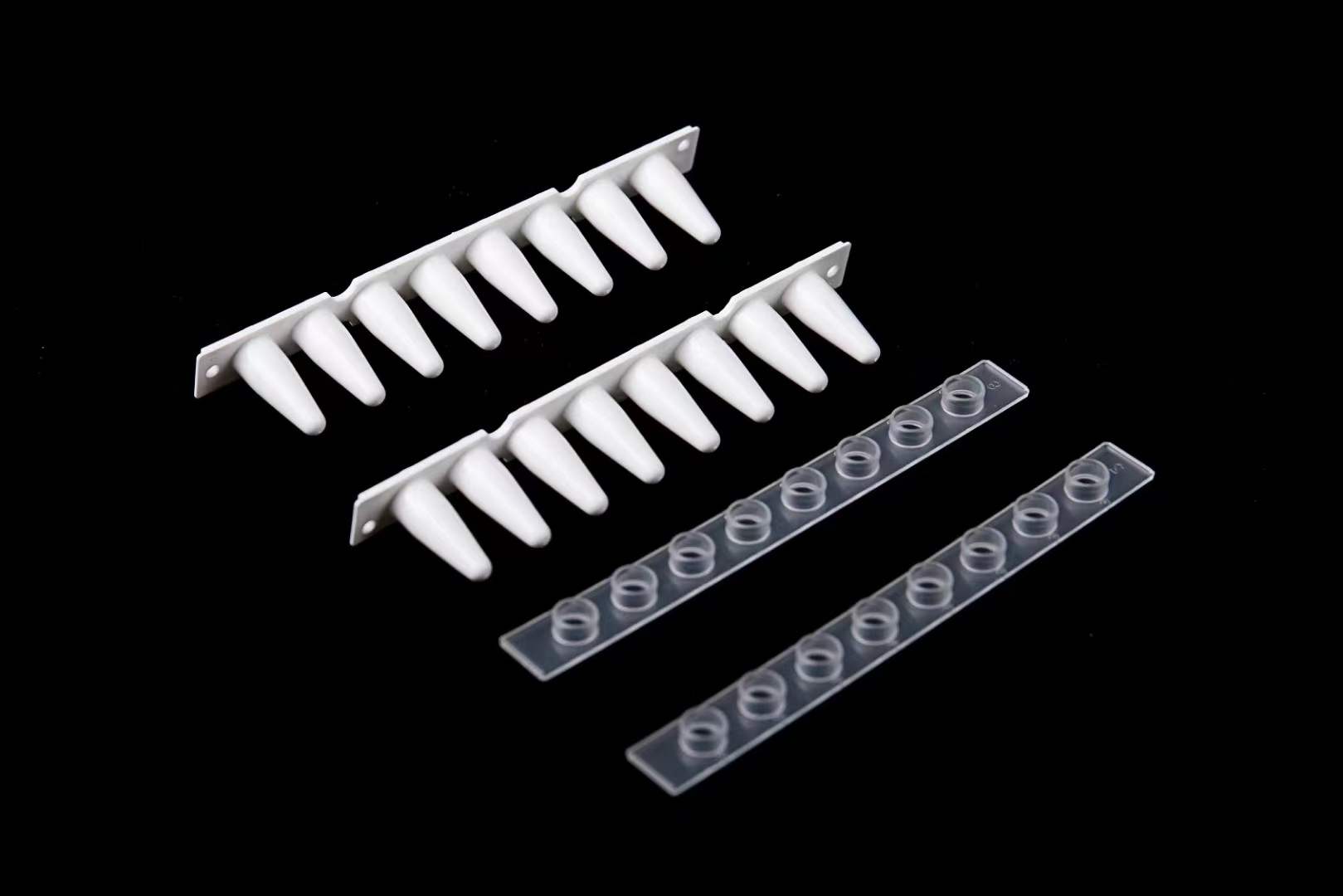
When limited reuse is defensible
There is one narrow case: a rough qualitative check, with no high-value sample, where the answer only needs to be yes or no. Under those conditions a virgin medical-grade polypropylene tube can be cleaned and used once more — twice at the absolute limit — following a documented protocol:
- Rinse the tube three times with deionised water immediately after the run, before the residue dries.
- Soak overnight in 0.1 per cent DEPC solution to destroy nucleases.
- Autoclave at 121 °C for 30 minutes.
- Dry at 60 °C before use, and inspect for clouding or deformation. Discard anything that has changed shape.
Note what this protocol cannot do: it will not remove amplicon from the cap thread reliably, and it does not restore the wall geometry. It reduces risk, it does not eliminate it.
What must never be reused
| Situation | Why reuse is ruled out |
|---|---|
| qPCR and any quantitative assay | Cq shift and well-to-well variation destroy comparability |
| Clinical or diagnostic testing | Traceability and validation requirements; a reused tube cannot be defended |
| Low-copy template work | Carry-over at that sensitivity is decisive |
| Any run with a no-template control that must be clean | Contamination shows up precisely where the control is judged |
| Multiplex or sequencing library prep | Index cross-over is unrecoverable and often silent |
The arithmetic usually settles it
Set the cost of one PCR tube against the cost of an amplicon contamination event: a repeat run, a wasted plate, a day of decontamination, and the risk that a result already reported was wrong. Even at the extreme, reuse saves a fraction of the consumable budget of a single experiment. The only situation where it makes financial sense is a teaching lab running non-critical demonstration reactions, and even there the habit is a bad one to teach.
Reduce the need instead
- Order the right format. Single tubes for small numbers of reactions, 8-strip and 96-well plates for batches; buying single tubes for a plate-scale experiment is what creates pressure to reuse.
- Plan the master mix. Most “wasted” tubes are reactions set up and then not needed because the plate was not planned to fill.
- Keep tubes out of the pre-PCR area once used. A used tube that returns to the clean bench is a contamination source regardless of whether it is reused.
- Buy thin-walled tubes with a consistent wall thickness. Thermal contact depends on it, and a cheap tube with an uneven wall behaves like a reused one from the first cycle.
Related reading
Note: The information on the scientific research products above is for reference only!
Related BUNSEN products
- PCR plates and 8-strip PCR tubes
- qPCR sealing films and foils
- Product Center — all BUNSEN lab consumables & instruments
Browse the full product range, or request a sample or quotation.
Leave a Reply