A mini benchtop centrifuge is not a smaller version of a floor-standing machine. It exists for the short, frequent spins that happen between steps: pulling liquid off a tube cap, settling a reagent before you open it, levelling a plate before it goes into the cycler. None of those warrant a full-size run, and all of them cost a sample if they are skipped.
The format that makes this work is compact, stops automatically when the lid is opened, and runs quietly enough to sit at the bench rather than in a separate room.
1. Blood samples, before they sit
For 1.5 mL micro blood-collection tubes and fingerstick samples, a short spin at 4,000–6,000 rpm separates cells from plasma or serum and gives a first stratification. Doing it at the collection point rather than sending the tube to a central lab is the point: blood that stands too long haemolyses, and haemolysis ruins the downstream nucleic acid work before it begins.
That makes the mini centrifuge useful in primary-care clinics and at field sampling sites, where it shortens the wait before extraction.
2. Spin-down after every extraction step
Lysis buffer and eluent cling to the cap and the tube wall. A few seconds of spin brings all of it to the bottom, where the sample actually is.
Skip this and the loss shows up as poor recovery — most visibly with trace DNA or RNA, where a few microlitres left on the wall is a meaningful fraction of the total. No programme has to be set: close the lid, it runs, it stops. It is probably the single most repeated operation in a molecular lab.
3. Before the PCR reaction
After adding master mix, primers and template, a brief spin settles everything off the tube wall and removes bubbles from the liquid column. That matters for three reasons: bubbles expand during thermal cycling and can push reaction out of the tube, trapped air distorts the volume, and uneven starting volumes produce well-to-well differences that look like assay noise.
Both 0.2 mL single tubes and 8-strip tubes are handled, and a whole strip can be spun at once — which is the difference between preparing a strip and preparing eight tubes one at a time.
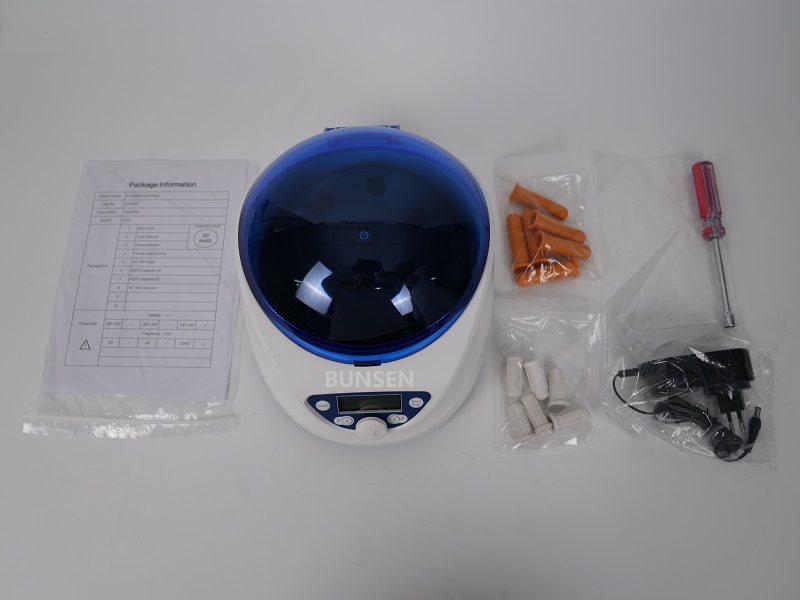
4. Reagent aliquots
Primers, enzymes and probes arrive as lyophilised powder or as concentrate, and both sit on the wall of the tube after shipping. A short spin before opening brings the material down.
Without it, opening the cap can throw powder into the air — a splash that wastes an expensive reagent and, worse, distributes nucleic acid aerosol across the bench. It works with 0.5 mL and 1.5 mL tubes and does not tie up the high-speed machine for a ten-second job.
5. Sealed plates, before cycling
Once a 96-well PCR plate is sealed, a short low-speed spin with a microplate adapter drives liquid off the well walls to the bottom. Two problems go away at once: peripheral wells no longer sit at a different level from the middle of the plate, and the edge wells lose less volume to evaporation during the run.
The five applications at a glance
| Application | What the spin prevents | Setting |
|---|---|---|
| Blood sample pre-separation | Haemolysis from standing; waiting for a lab | 4,000–6,000 rpm, short |
| Spin-down after extraction steps | Loss on cap and wall; low recovery of trace nucleic acid | Seconds |
| Before PCR | Bubbles, overflow during cycling, well-to-well volume differences | Brief |
| Reagent aliquots | Splash and aerosol on opening; wasted reagent | Brief |
| Sealed PCR plates | Uneven levels and edge evaporation | Low speed, short, plate adapter |
Frequently asked questions
Can a mini centrifuge replace a benchtop centrifuge?
No. It covers short, low-to-moderate speed spins. Separations that need high RCF, larger volumes or long runs still belong on a full-size machine.
What speed for a spin-down?
Enough to move liquid off the wall and no more — a few thousand rpm for a few seconds. Higher speeds add nothing and heat the sample.
Why spin a plate after sealing?
To level the wells and cut evaporation from the edge wells. It is a small step that removes a common source of well-to-well variation.
Related reading
Note: The information on the scientific research products above is for reference only!
Leave a Reply