Short answer: yes — for the pre-incubation step, not for the assay itself. A U-bottom low-binding 96-well plate is a good vessel for diluting, neutralising or pre-mixing a sample before it goes onto the ELISA plate. It is not a substitute for the coated plate, because it has no polystyrene activation and cannot immobilise capture antibody.
What the pre-incubation step is for
Before a sample reaches the coated plate it often has to be diluted, neutralised against an interfering matrix, or pre-mixed with blocking solution or a neutralising antibody. That happens in a separate vessel, and whatever is lost in that vessel never reaches the assay. With a low-abundance analyte, the vessel is the problem.
Why a U-bottom low-binding plate
- Adsorption. BUNSEN specifies an electrically neutral, inert hydrogel coating covalently bound to the well wall, which holds antibody, antigen and protein adsorption below 0.1 %. On ordinary microplates a meaningful fraction of a dilute analyte adsorbs to the plastic and is never measured.
- Recovery. For low-abundance samples the manufacturer reports recovery improved by more than 20 % against conventional plates — which is the difference between a signal and no signal at the bottom of a standard curve.
- U-shaped base. Sample and pre-incubation reagents collect at the centre of the well, so micro-volumes mix thoroughly without vigorous shaking and without the local heterogeneity you get on a flat base.
- No added background. A super low-binding surface does not induce the non-specific conformational changes associated with TC-treated plates, so it does not add a background that competes with the antigen–antibody reaction you are trying to measure.
- Fits automation. ANSI/SBS footprint, so it loads straight onto pipetting workstations, and the pre-incubated sample can go directly to the ELISA plate by multichannel pipette without an intermediate vessel.
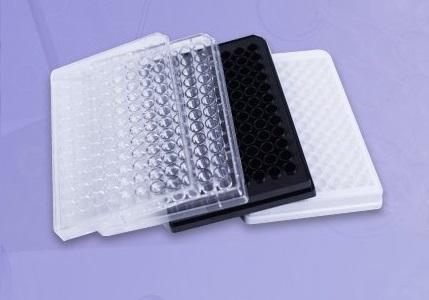
Where it fits — and where it does not
Good fit: low-abundance cytokine ELISA, microcirculation marker detection, pre-neutralisation of valuable clinical samples, and pre-reaction of serially diluted samples where every microlitre of recovery counts.
Not a fit: as the assay plate. Without polystyrene activation the surface cannot capture antigen or antibody by passive adsorption, and it is not intended for the final colorimetric read. Pre-incubate here, then transfer to the coated plate.
Practical notes
- Keep the pre-incubation volume between 50 and 200 µL per well.
- After incubation, aspirate the whole volume with the tip held against the well wall. That reduces residue and keeps the volume accurate for the next addition.
- Because the plate is SBS-standard, the transfer to the ELISA plate can be done with a multichannel pipette in one pass — no intermediate tube rack.
Frequently asked questions
Can I read the ELISA directly in the low-binding plate?
No. It is a pre-incubation vessel. The colourimetric reaction belongs on the coated assay plate.
Does the U-bottom matter if I am only diluting?
It helps at small volumes. A U-bottom collects the liquid at one point, so a 50 µL pre-mix mixes properly without shaking; on a flat base the same volume spreads thin and mixes unevenly.
Is a low-binding plate the same as a TC-treated plate?
No — and that is the point here. TC treatment is designed to make cells attach; it also introduces non-specific protein interaction. A low-binding surface is engineered for the opposite.
Related reading
Note: The information on the scientific research products above is for reference only!
Leave a Reply