The two are often stored in the same drawer and confused in the same sentence, but they are different instruments. A Pasteur pipette transfers liquid; a serological pipette measures it. That single difference decides which one belongs in a protocol, and using one in place of the other is the source of a surprising number of failed dilutions.
The short answer
A Pasteur pipette has no graduations. Volume is estimated by eye and experience, and the error on a transferred volume typically exceeds 30 per cent. A serological pipette (often sold as a “serum pipette”) carries moulded bidirectional graduations and is calibrated to within about ±1 to ±2 per cent, which makes it a measuring instrument rather than a transfer tool.
Accuracy, plainly stated
| Pasteur pipette | Serological pipette | |
|---|---|---|
| Graduations | None | Moulded, bidirectional, colour-coded by volume range |
| Typical error | Estimated; over 30 per cent | ±1 to ±2 per cent as calibrated |
| Fit for quantitative work | No | Yes, within its stated tolerance |
Note what “±1 to ±2 per cent” means in practice: at 10 mL, a 2 per cent error is 200 µL. That is acceptable for preparing buffer and unacceptable for a standard curve. Calibrated does not mean exact.
Construction and how the liquid moves
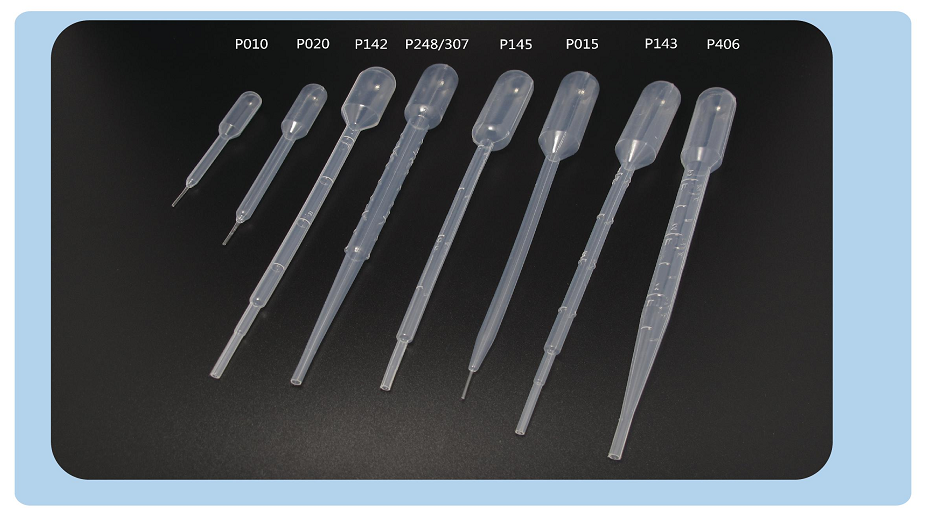
Pasteur pipette. Blow-moulded in one piece from polyethylene, so the whole tube is flexible. You squeeze the bulb or the tube itself to create the vacuum, and the liquid follows. There is no separate bulb to lose and no filter plug at the tip. The design is cheap, robust and completely non-quantitative.
Serological pipette. Made from rigid polystyrene (GPPS), which cannot be squeezed. It is used with a manual pipette pump or an electric pipettor, and the seal at the top is what makes aspiration controllable. Because the body is rigid and straight, the graduations can be moulded accurately along its length.

The filter plug is not a minor detail
Good serological pipettes carry a hydrophobic polyester or sintered polyethylene plug near the top. It passes air, blocks aerosols and stops liquid from reaching the pipettor. Without it, a single over-aspiration pulls medium into the pump body, and every subsequent use of that pump is a contamination risk. On a shared instrument used by six people, that is how a culture room gets an infection it cannot trace.
Where each one belongs
| Task | Correct tool | Why |
|---|---|---|
| Removing spent medium before a wash | Pasteur | Volume is irrelevant; speed and reach matter |
| Loading an agarose gel | Pasteur (fine tip) | Needs a narrow tip and a steady squeeze, not a measurement |
| Adding a few drops of reagent | Pasteur | Approximate by design |
| Aliquoting medium into flasks | Serological | Each flask needs the same volume |
| Gradient dilution of a cell suspension | Serological | The dilution factor depends on an accurate transfer |
| Dispensing serum or supplement into medium | Serological | Small volumes of expensive reagent, sterile handling |
Bulk versus individually wrapped
Pasteur pipettes are usually supplied in bulk bags of 500, in 1 mL, 3 mL and 5 mL sizes, non-sterile by default. They are cheap enough to be treated as disposable transfer tools.
Serological pipettes come individually wrapped and gamma sterilised when they are intended for cell work, in a range from 1 mL to 50 mL. The packaging is part of the product: an individually wrapped pipette can be opened inside a clean bench without the outer surface contaminating the tip.
Two habits worth fixing
- Using a Pasteur pipette to “measure” a small volume. The tip geometry makes drops inconsistent, and the error compounds across a dilution series.
- Using a serological pipette to remove waste liquid. You pay for calibration and sterility on every unit, then use it as a spatula. Keep a bag of Pasteur pipettes next to the aspirator.
Related reading
Note: The information on the scientific research products above is for reference only!
Leave a Reply