A media bottle fails in one of four ways: it leaks in transit, it contaminates the culture, it spoils the medium, or it breaks while someone is holding it. Each failure traces back to one decision made at purchase — material, cap, neck, or the certificate that came with the box. Here is what to check, in the order that matters.
Material: choose it from the process, not the price
The usual options cover different jobs, and no single resin is best at all of them.
| Material | Good for | Watch out for |
|---|---|---|
| PET | Prepared media, buffers, aqueous solutions; clear walls for visual inspection | Poor solvent resistance; deforms at autoclave temperatures |
| PETG | General laboratory storage with better impact resistance than glass | Also single-use for practical purposes; not for autoclaving media inside |
| HDPE | Long-term storage, opaque solutions, cheap bulk handling | Translucent, so you cannot see the liquid; strong chemical resistance but weak optical check |
| Borosilicate glass | Autoclaving, heat-sensitive work, repeated use | Breakage risk, weight, and cleaning validation if reused |
| Polycarbonate | Reusable autoclavable bottles with high impact strength | Attacked by some solvents and by repeated alkaline cleaning |
Two checks decide between them. First, chemical compatibility with the actual solution — pH, salts and any organic solvent, not just “water-like”. Second, whether the bottle will be autoclaved: if yes, the polymer must be able to take 121 °C, and most transparent single-use resins cannot.
For deep-freeze storage, check the manufacturer’s stated low-temperature limit rather than assuming. A bottle rated to −40 °C and a bottle rated to −80 °C look identical on a shelf.
For clear media, reject any bottle that is visibly hazy, scratched or contains black specks. Light transmittance of roughly 90 per cent or better on a clean PET wall is the practical baseline for inspecting a culture by eye.
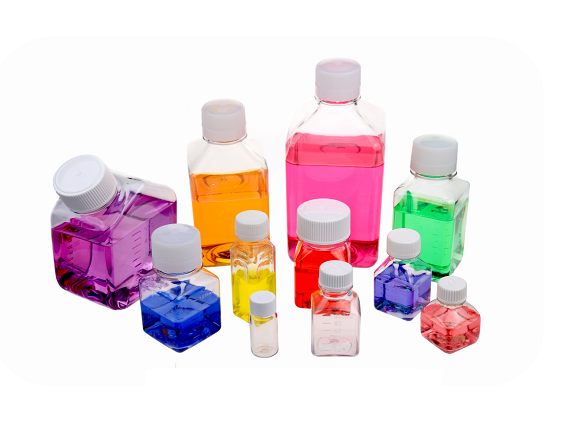
The cap decides whether the culture breathes
This is the most commonly mis-ordered part of a media bottle. A standard screw cap is leak-proof: it holds liquid and it holds gas, which means a culture inside it will consume the oxygen in the headspace and drift in pH as CO₂ accumulates.
A vented cap carries a hydrophobic membrane, typically 0.22 µm, that passes gas but not organisms. That single component is what turns a storage bottle into a culture vessel, and it is what keeps the medium at the CO₂ level the incubator is trying to maintain.
| Cap type | Use it for | Do not use it for |
|---|---|---|
| Leak-proof screw cap | Storage, transport, freezing, aliquots | Anything that must exchange gas |
| Vented cap, 0.22 µm hydrophobic membrane | Cell culture, media in the incubator, shaking cultures | Shipping or freezing — the membrane is not a liquid seal under pressure |
If a bottle is going to travel, ship it with a solid cap and swap to a vented cap at the point of use. Sending a vented bottle by courier is how media arrives leaking and how a whole consignment is written off.
Neck and graduations: small details that decide daily usability
- Wide neck admits a pipette, a serological pipette or a cell scraper without touching the wall. It is the practical choice where medium is aliquoted many times per week.
- Narrow neck reduces the open area during handling and is easier to close aseptically, but it slows pipetting.
- Graduations should be moulded, not printed. Printed scales wear off in an autoclave and, worse, flake into the medium.
- Capacity range of 10 mL to 1000 mL covers most workflows; pick the smallest bottle that holds the batch so the headspace stays reasonable.
Sterility and certification: read what is claimed
Four claims appear on media bottle packaging and they are not interchangeable: sterile, DNase/RNase-free, pyrogen-free (endotoxin), and biocompatibility. Cell culture needs all four; plain buffer storage needs the first.
- Sterilisation route. Gamma irradiation is the standard for single-use bottles because it leaves no ethylene oxide residue and requires no further handling. If the product is sterilised by ethylene oxide, ask for the residue declaration.
- Endotoxin. Pyrogen-free matters for anything that touches cells or is injected downstream. A bottle that is sterile but not pyrogen-free can still ruin a primary culture.
- Biocompatibility. ISO 10993 is the reference standard for material safety; if a supplier cannot name the part they comply with, treat the claim as marketing.
Supplier checks before the first order
| Check | What a good answer looks like |
|---|---|
| Cleanroom class | A stated class (Class 100,000 / ISO 8 or better) for moulding and packing, not “clean workshop” |
| Quality system | ISO 9001 certificate with a current expiry date and a scope that covers labware |
| Sterility documentation | Irradiation dose and a certificate per lot, not a generic statement |
| Traceability | Lot number on the carton that maps to a production record |
| Consistency | Same mould, same resin, same cap across repeat orders — ask what changes between lots |
The five-minute pre-purchase checklist
- Does the material survive my sterilisation route and my storage temperature?
- Is the cap leak-proof or vented — and do I need both, on different bottles?
- Is the neck wide enough for the tool I actually use to fill it?
- Is the certification specific to the claim I need: sterile, pyrogen-free, DNase/RNase-free, biocompatible?
- Can the supplier show lot traceability and a cleanroom class in writing?
Related reading
Note: The information on the scientific research products above is for reference only!
Leave a Reply