PCR consumables get treated as commodities, but two decisions determine whether a run works: whether the plate physically and thermally fits your instrument, and whether the seal survives 40 cycles at 95 °C. Everything else is packaging.
Skirt style decides what the plate fits
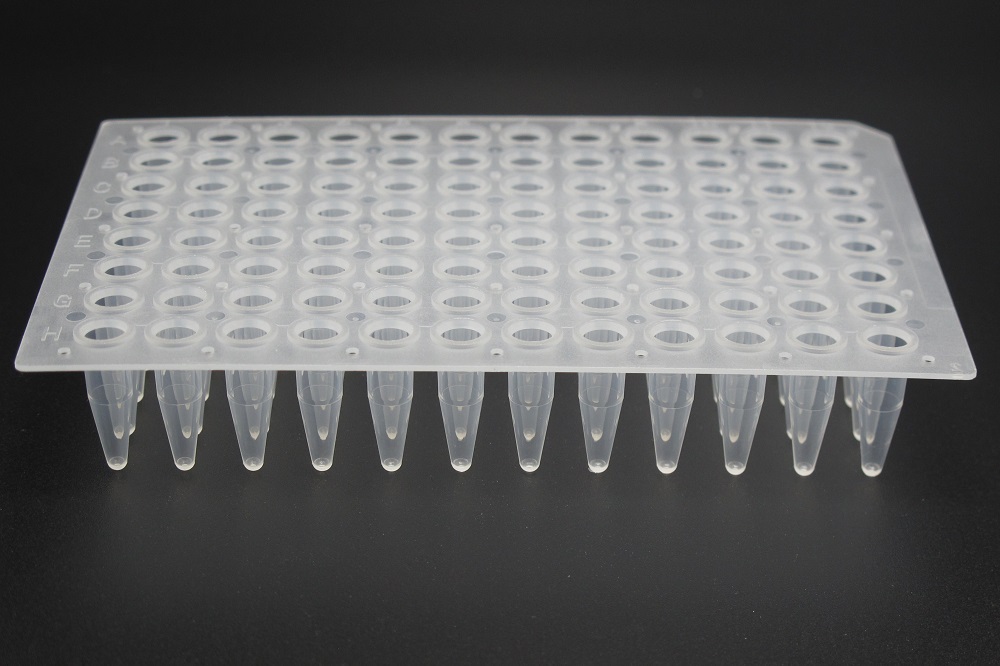
- Non-skirted — the cheapest, and compatible with the metal block of traditional PCR instruments. It flexes, so it is a poor choice for robotic handling.
- Semi-skirted — fits the large majority of qPCR instruments and automated workstations. This is the practical default if you are unsure.
- Fully skirted — rigid, with a raised tab that robotic grippers can locate, which prevents misalignment during high-throughput handling. Also the most stable choice if the same plate is used as a storage index.
Material and well volume
Medical-grade polypropylene is the standard because it is thin-walled and thermally uniform. Thin walls matter more than they sound: they transfer heat faster, and a well-made thin-walled plate cycles roughly 30 % faster than a thick-walled one, which shortens the run and reduces non-specific amplification.
Choose 96-well for routine work and 384-well only when you genuinely need the throughput — the working volume drops and pipetting tolerance becomes tighter. Well volume must match the instrument’s thermal module: 0.1 mL and 0.2 mL formats are not interchangeable.
Biosafety labels that matter
Confirm the plate is stated as DNase-free, RNase-free and pyrogen-free. On a qPCR plate these are not marketing terms: exogenous nucleic acid produces false positives, and nuclease contamination causes Ct drift that looks like a biological effect and is not.
Matching the sealing film to the application
The film exists to stop evaporation and contamination, but the wrong film can also block the optics or fail at temperature. Match it to the run, not to what is in the cupboard.
| Application | Film type | What it must do |
|---|---|---|
| Standard PCR | PP adhesive or aluminium foil heat seal | −40 to 120 °C, hold pressure through 95 °C cycling |
| qPCR | Optical pressure-sensitive film | Transmission above 90 %, low autofluorescence |
| Storage at −80 °C | Thickened adhesive film | Very low water-vapour transmission, no embrittlement |
| Automated workstations | Heat-seal film | Thickness tolerance ≤ ±0.02 mm for automated sealers |
| Culture-adjacent PCR | Breathable film | Gas exchange without spillage or cross-contamination |
A sealing procedure that survives thermal cycling
- Prepare the bench. UV the work surface for 30 minutes and wear powder-free gloves. Reseal the bag immediately after removing one film — the rest of the pack has to stay nuclease-free.
- Apply at an angle. Peel the backing along the tangent, align one end with the plate edge, and smooth the film down at about 30° so you are pushing air ahead of the adhesive rather than trapping it.
- Do not touch the adhesive. Contact anywhere on the glue layer is how bubbles and creases start.
- Press evenly. Using a smooth-edged applicator or card, press twice horizontally and twice vertically, working the edges and the gaps between wells. Firm, not brutal — excessive pressure pushes liquid out of the wells.
- Inspect every well. No gaps at the edge, no creases across the surface.
- Let it set, then spin. Leave the sealed plate for 10 minutes so the adhesive bond strengthens, then brief-centrifuge at 500 ×g for one minute to bring liquid and bubbles down before the run.
Common failure modes
- Film lifting at one corner after 30 cycles — usually a plate that was not dry at the rim, or the wrong film for the temperature.
- High fluorescence background in qPCR — an opaque or high-autofluorescence film instead of an optical one.
- Film delaminating in the freezer — an adhesive film not rated for −80 °C.
- Evaporation from edge wells — an incomplete seal that only shows up in the outer columns.
Related reading
Note: The information on the scientific research products above is for reference only!
Leave a Reply