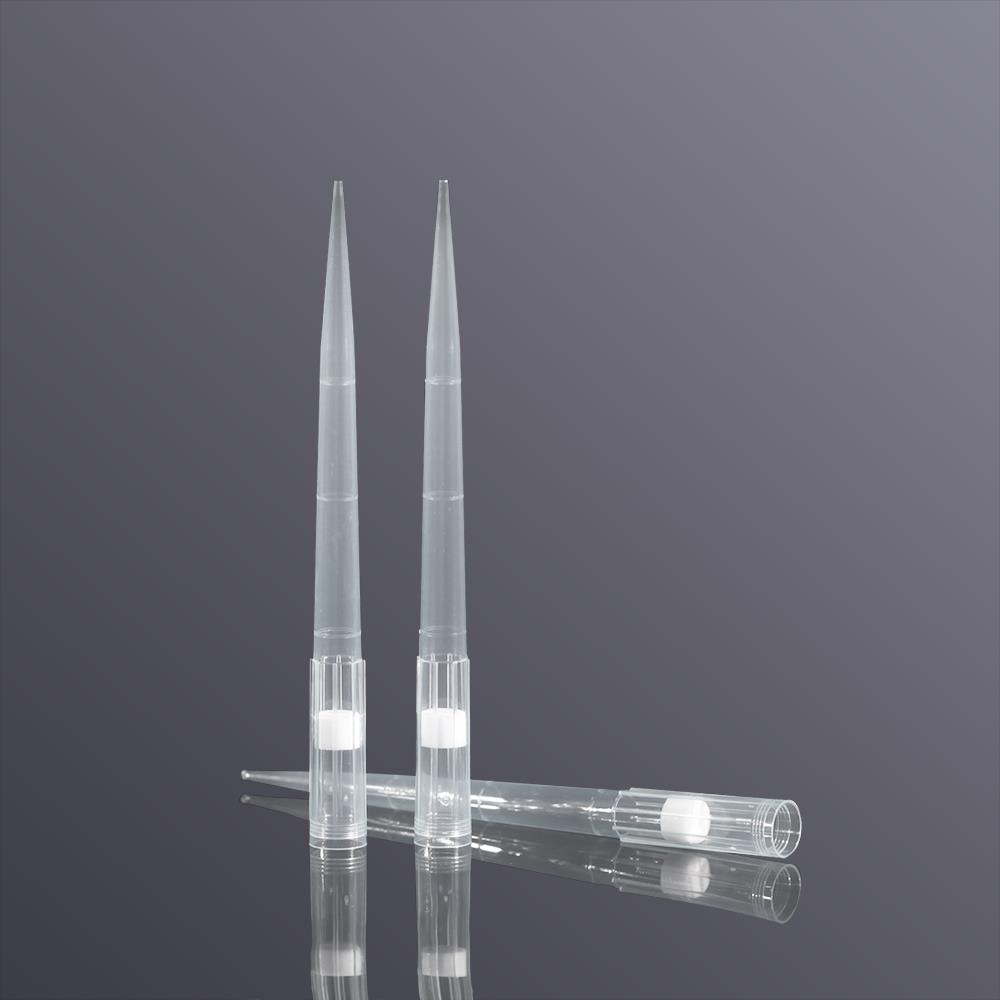
A 10 µL tip is for the smallest volumes in the lab — a few microlitres of template, primer or enzyme. Making it extended and filtered solves two practical problems at the same time: reaching the bottom of a narrow vessel, and keeping the pipette barrel out of the aerosol path.
What the extended length changes
A standard 10 µL tip is short. That is fine in a shallow microplate well, but in a deep-well block, a PCR tube or a microcentrifuge tube the tip stops well above the liquid. The extended version adds reach so that the tip can draw from the bottom of these containers without the barrel touching the rim.
The practical gain is twofold: you can withdraw the last few microlitres instead of abandoning them, and the pipette shaft stays clear of the vessel mouth — which matters when that mouth has just been through a thermal cycler.
What the filter is for
The filter in the tip is an aerosol barrier. It sits between the sample and the pipette barrel, so aerosols generated during mixing, vortexing or pipetting up and down stay in the tip rather than travelling up into the shaft.
- It protects the instrument. A contaminated barrel will carry nucleic acid into the next sample, and it is not something you can see or clean easily.
- It reduces cross-contamination between samples — the failure that shows up as a band in a no-template control.
- It complements sterility rather than replacing it. Filtered and sterile are separate claims; a boxed, sterile pack is what you want for work where both matter.
Where these tips are used
- PCR and qPCR setup. Dispensing template, primers and master mix in single-digit microlitre volumes, where the filter keeps aerosols out of the pipette.
- Nucleic acid extraction and detection. DNA and RNA work where a stray aerosol from the previous sample is a false positive waiting to happen.
- Genotyping and sequencing preparation. Cleanliness requirements are high and volumes are small, so both features earn their place.
- Cell culture media and reagents. Accurate pipetting of small reagent volumes with the pipette kept clear of the vessel.
- Protein and biochemistry work. Protein quantification, enzyme reactions and buffer preparation, all of which are microlitre-scale.
- Transfers between plates and tubes. Moving micro-volumes between 96-well plates, PCR plates and centrifuge tubes — the case where reach and cleanliness both matter.
When a shorter tip is the better choice
Extended tips are not a universal upgrade. In a shallow 96-well plate the extra length puts the tip closer to the well wall, which makes touching off droplets harder, and the longer column of air slightly changes how a 1–2 µL volume behaves on aspiration. If the vessel is shallow and the volume is tiny, a standard 10 µL tip is often the more controllable option.
Frequently asked questions
Are filtered tips sterile?
Not automatically — they are two separate properties. Look for tips that are both filtered and supplied in sterile, individually sealed boxes if your workflow needs both.
Why use an extended tip for a deep-well plate?
Because a standard 10 µL tip cannot reach the liquid at the bottom of the well. The extended tip draws from the base of the well without the barrel entering the plate.
Can I use 10 µL filtered tips with any pipette?
They fit pipettes that accept the standard 10 µL tip cone. For pipettes with a proprietary shaft — Rainin LTS being the common example — a dedicated tip series is required.
Related reading
Note: The information on the scientific research products above is for reference only!
Leave a Reply