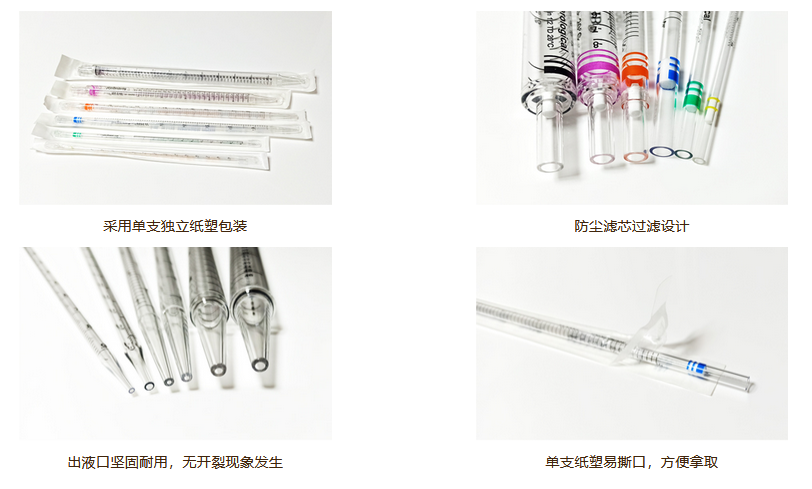
BUNSEN serological pipettes run from 1 mL to 50 mL, each one gamma sterilised and individually wrapped in paper-plastic film, so it can be opened inside a clean bench and used immediately. They are intended for cell culture and other work where both accuracy and sterility are part of the result.
The range at a glance
| Nominal volume | Moulding route | Typical use |
|---|---|---|
| 1 mL | Stretch-moulded body | Small supplement additions, single-well work |
| 2 mL | Stretch-moulded body | Reagent addition to small flasks |
| 5 mL | Stretch-moulded body | General medium aliquoting |
| 10 mL | Stretch-moulded body | Standard flask and tube filling |
| 25 mL | Ultrasonically welded tip | Larger medium batches, viscous serum |
| 50 mL | Ultrasonically welded tip | Bulk dispensing, roller bottle work |
Every size is individually packaged and gamma irradiated. Nothing needs to be autoclaved before use, and nothing needs to be unwrapped outside the bench.

What the accuracy figures mean
The body carries bidirectional moulded graduations, so a volume can be read on the way up or on the way down, and the colour-coded band identifies the size at a glance across a crowded bench.
Standard models are calibrated to within about ±2 per cent of the nominal volume. The high-precision, ink-free version holds the error to about ±1 per cent, and because there is no printed ink on the inside of the tube, there is no risk of pigment flaking into the medium — a real concern with older printed-scale pipettes used for sensitive culture work.
Read the tolerance against the volume you are actually dispensing. Two per cent of 1 mL is 20 µL; two per cent of 50 mL is 1 mL. The relative error is the same, the absolute consequence is not.
Two moulding routes, and why both exist
Stretch-moulded bodies (1 to 10 mL). Formed in one piece so the inner and outer walls are smooth and free of seams. A smooth bore is what reduces liquid held on the wall after dispensing, which matters when the last few hundred microlitres of a serum addition are the expensive part.
Ultrasonically welded tips (25 and 50 mL). At large volumes the draw force on the tip is high and the liquid is often viscous. An ultrasonically welded tip joint gives greater structural strength than a purely moulded taper, and keeps the tip concentric so dispensing a viscous serum or a dense cell suspension stays controllable.
The filter plug and the universal end
Each pipette carries a sintered polyethylene plug near the top. Air passes through it; aerosols, fibres and liquid do not. That plug is what protects the pipettor, and protecting the pipettor is how a shared instrument stays usable for the next person.
The top end is a universal design that fits the great majority of manual pumps and electric pipettors without an adapter. Before committing to a full case, fit one pipette to each pipettor in the lab and check two things: that it seats without force, and that it ejects cleanly.
Cleanliness and safety claims
- Produced on automated lines in a Class 100,000 cleanroom.
- Free from DNase and RNase, pyrogen-free, and screened for endotoxin and cytotoxicity.
- Suitable for primary cell culture and stem cell handling, where a trace of endotoxin or nuclease shows up as a failed experiment rather than a failed sterility test.
Opening one aseptically
- Bring the unopened pipette into the bench and let it sit for a moment; the outer wrap is not sterile and does not belong above an open flask.
- Tear the paper-plastic wrap from the top end, keeping the tip inside the wrapper.
- Seat the pipette on the pipettor while it is still partly wrapped, then peel the rest away. The tip never touches the outside of the packaging.
- Never lay a loaded pipette down on the bench surface. If it must be set down, use a pipette stand or return it to the wrapper.
FAQ
Are these pipettes reusable?
No. They are single-use sterile consumables. Washing and re-sterilising destroys the calibration and the plug, and there is no way to validate the result.
Can the 50 mL pipette be used with a manual pump?
Yes, provided the pump is rated for 50 mL. A pump sized for 25 mL will not hold the column steadily, and the draw will be uneven.
Why choose individually wrapped over bulk?
Because the wrap is the sterile barrier for the tip. Bulk-packed pipettes are cheaper per unit but cannot be opened inside a bench without exposing the tip to the outer packaging surface.
Related reading
Note: The information on the scientific research products above is for reference only!
Leave a Reply