A pipette tip is the last thing between the sample and the experiment, so the volume range printed on the box is only the first of several decisions. The three sizes below cover almost all routine laboratory pipetting, but they are not interchangeable, and the grade you choose within each size matters just as much as the size itself.
10 µL pipette tips (white)
These are the tips used for the smallest volumes in the laboratory, matched to pipettes with a 0.5–10 µL range. The tips are finely drawn and most are extended-length, so they reach the bottom of a 0.2 mL PCR tube or a 0.2 mL microcentrifuge tube without the barrel of the pipette touching the rim.
Applications. Setting up qPCR reactions, diluting primer and probe stocks, preparing single-cell sequencing libraries, and adding restriction enzymes to a digestion. At this scale the quality of the tip shows up directly in the pipetting CV, which can be held to within about 1 % — the difference between recovering a precious reagent and losing it to a systematic under-delivery.
What to choose. For high-sensitivity nucleic acid work, take the extended-length filtered version, certified DNase-free, RNase-free and pyrogen-free, because an aerosol bridge is the classic route to a false positive. For routine dispensing where contamination is not a concern, the standard bagged tip is the cheaper option.
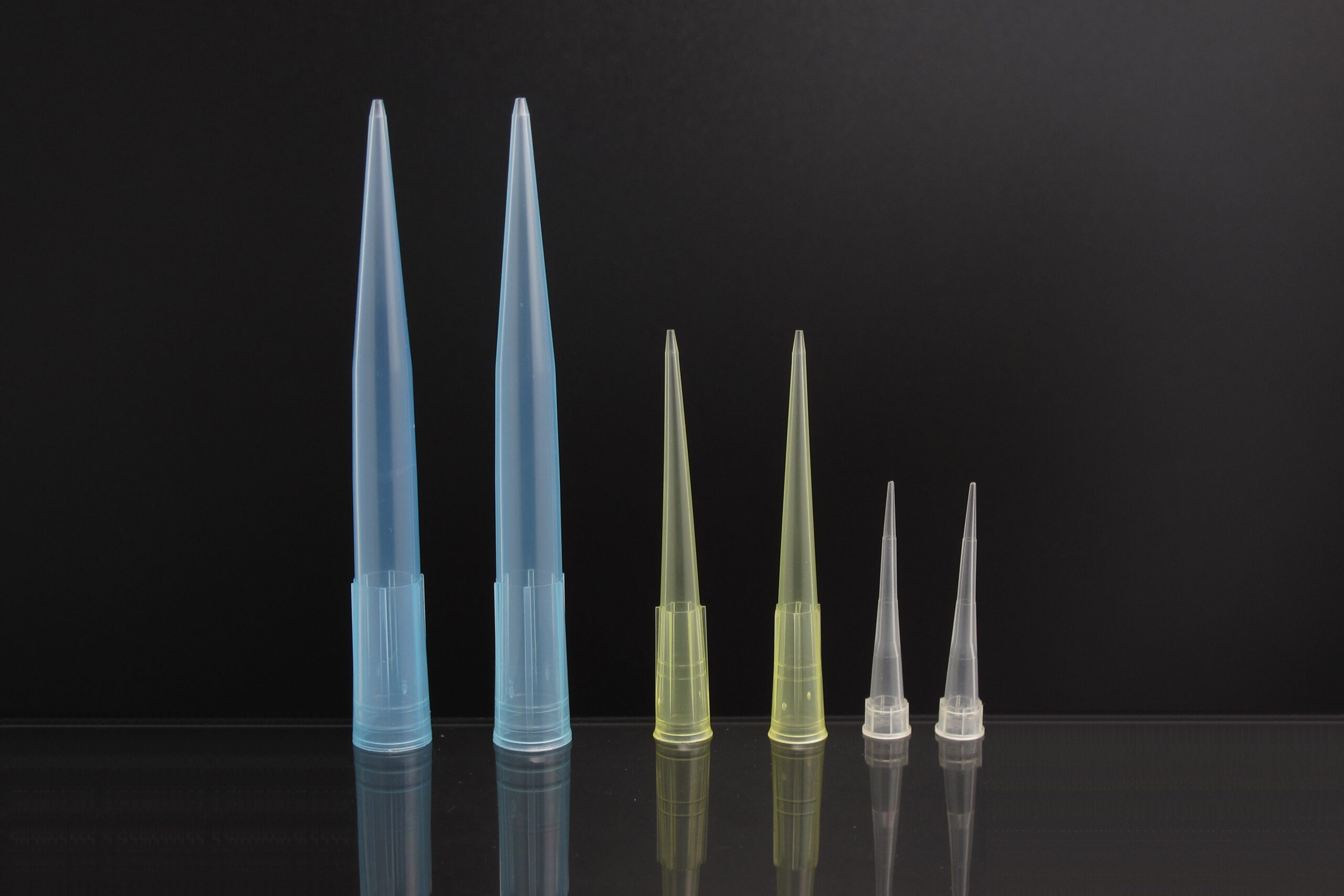
200 µL pipette tips (yellow)
The workhorse size in most laboratories, matched to pipettes with a 20–200 µL range, and the tip with which most routine work in 96-well plates and centrifuge tubes is done.
Applications. Filling ELISA plates, setting up routine PCR, serial dilution of serum samples, protein quantification, sample transfer, Western blot preparation and buffer make-up. The 200 µL tip is also the size that fits 8- and 12-channel multichannel pipettes, which is what makes 96-well work practical.
What to choose. For high-volume routine handling, buy the bulk bag and keep the cost per tip low. For qPCR, cell culture and anything where an exogenous nuclease or endotoxin would matter, take the pre-sterilised racked version — it arrives ready to load, removes the contamination risk of repacking by hand, and drops straight into an automated pipetting platform.
1000 µL pipette tips (blue)
The large-volume standard, matched to pipettes with a 100–1000 µL range. The barrel is wide, most tips carry clear graduations, and some are available in an extended length.
Applications. Aliquoting medium and buffer, transferring large volumes of lysis or wash buffer in nucleic acid work, gently adding medium during a medium change on adherent cells, and preparing bulk biochemical reagents. One 1000 µL delivery replaces a string of small-volume pipetting steps, and it is both faster and more reproducible.
What to choose. For cell culture, take the sterile tip with a smooth, burr-free orifice so that the tip cannot scratch the cell monolayer. For nucleic acid extraction, viral testing and any other high-contamination-risk workflow, use a tip with a hydrophobic filter, which blocks aerosol and protects both the pipette barrel and the next sample.
General rules for choosing pipette tips
Fit matters more than volume. A tip has to be matched to the brand and model of the pipette it will be used on, not only to the volume range. A tip that merely fits can seal poorly, leak, or deliver outside tolerance.
Material. Pipette tips are moulded from medical-grade polypropylene (PP), which resists acids and alkalis and withstands autoclaving at 121 °C, so it covers the great majority of standard laboratory applications.
Low retention. Where the sample is a low-abundance protein or a rare nucleic acid, a low-retention tip is worth the extra cost: non-specific binding to the tip wall can be held below about 0.1 %, which is often the difference between recovering the sample and losing it.
Related reading
Note: The information on the scientific research products above is for reference only!